


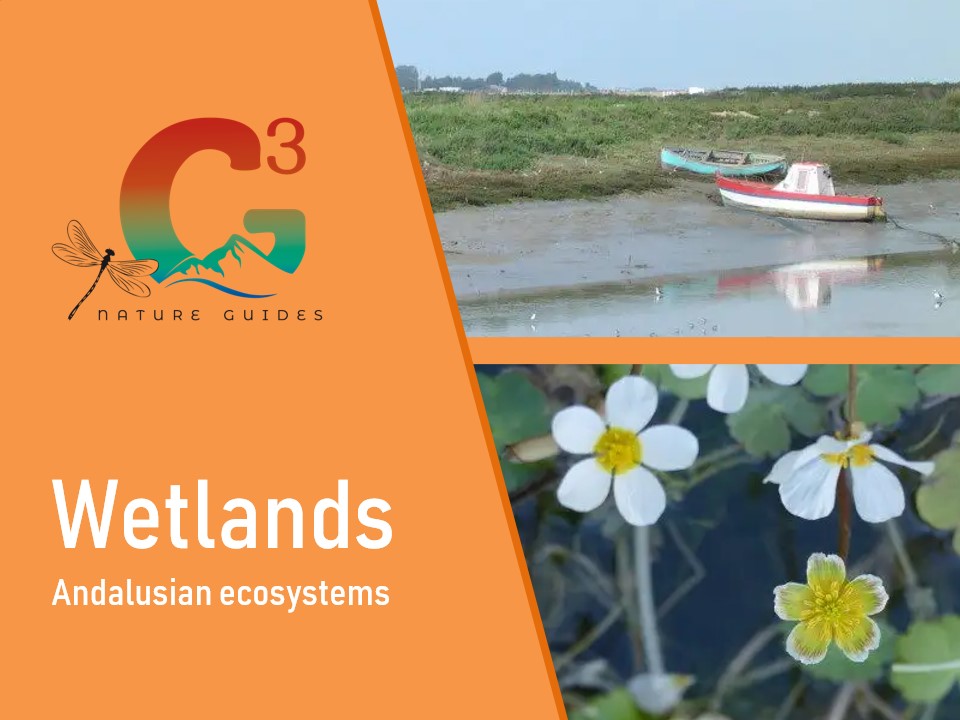
Ecosystems with maximum plant productivity – remarkable habitat for migratory birds and amphibians.

In Andalusia, as in the rest of Europe, the most important wetlands are found on the coast. It is at the mouths of rivers
(estuaries ), inplains suitable for water expansion and sediment deposition , where seasonal inflows ofriver water and the dailytidal regime coincide. These conditions are ideal for creating marshes: spaces of great complexity that harbor abundant biodiversity.
For the naturalist, the great attraction of wetlands in Andalusia lies in their morphological diversity, dependent on four highly variable factors such as their surface, their depth, their seasonality and their concentration of mineral salts, the combination of which creates an infinite number of ecological situations. The main biotopes are listed in the Inventory of Andalusian Wetlands.

Coastal wetlands, estuaries and marshes: the Atlantic basin is characterized by rivers of greater flow and tides of greater amplitude than the Mediterranean basin, thus hosting the most important wetlands of Andalusia: Castro Marim – Isla Cristina (Guadiana River), Marismas del Odiel (Odiel River), Doñana (Guadalquivir River), Bahía de Cádiz (Guadalete River), Marismas del Barbate (Barbate River) and its antechamber the Laguna de La Janda. As for the Mediterranean basin, it has some important coastal wetlands: Guadiaro and Guadalhorce river mouths , Charca de Suarez (Guadalfeo river), Salinas de Punta Entinas El Sabinar, Andarax, Salinas de Cabo de Gata and Almanzora.

Far from the coast, inland endorheic complexes are abundant in the Guadalquivir depression. These are drainage basins that form lagoons and do not discharge into the hydrographic network. The semi-arid climate of Andalusia means that these lagoons usually dry up before the next rainy season. In terms of vegetation, they are usually surrounded by a narrow strip of tamarisk. The

Mediterranean temporary ponds are small wetlands of a few hundred square meters, or much less, that dry up rapidly. Depending on the presence in the soil of

Wetlands are characterized by a primary production much higher than that of other continental ecosystems. They are home to highly specialized vegetation: aquatic, freshwater and saltwater amphibians (coastal and inland halophytic vegetation).
They are very important for biodiversity, particularly for aquatic avifauna, as a feeding and resting area. Temporary ponds and lagoons do not allow the survival of fish and crayfish

I have shown hundreds of temporary ponds that are literally teeming with life… I have often wondered how so many predatory insects can grow there. Another memory at the King’s Palace in Doñana: a distant pink mass of glowing Greater Flamingoes amidst the lush green marshes.
Leave a Reply