


Seville is much more than a great monumental city. Far from the clichés of the Mediterranean coast, the capital of Seville fuses the Spanish culture of the interior with the heritage of the Gateway to America. Its true potential lies in its proximity to Doñana, one of the most famous national parks in Europe, without forgetting Sierra Morena, the Andalusian steppes and other areas of international interest for bird watching.
The strategic position of the city of Seville as the head of the Guadalquivir estuary makes it an exceptional base camp, both comfortable and full of character, to explore the extraordinary ornithological diversity of the Iberian southwest and western Andalusia. Few European capitals can offer such a rich and profitable variety of ornithological excursions. It is no coincidence that the birds of the marshes are among the must-see (to-do lists) of the most reputable travel guides. The Guadalquivir River and its estuary, with world-famous areas such as Doñana(detailed guide to the Doñana natural area), are the backbone of this privileged observation territory.
Ornithological richness in the province of Seville
The Guadalquivir River defines the character of Seville, and its banks are home to some of its most emblematic monuments. But beyond its urban landscape, the river acts as the great ecological corridor that allows a multitude of wildlife species to disperse, connecting from the most remote mountain ranges to the immensity of its watershed. In this sense, it is often said that the Guadalquivir is the backbone of Andalusia.
The figures speak for themselves: ornithological platforms record more than 320 species for the province of Seville, with an annual average of more than 250 different ones and an upward trend since 2016 and a maximum of 268 species sighted in a single year. These numbers are extraordinary for a province without seabirds and shorebirds, reflecting an ornithological wealth that is accessible, documented and in full effervescence.
Birdwatching tours in the province of Seville

Among the most endangered birds that find a last refuge in the province of Seville are the Marbled Duck (Marmaronetta angustirostris), the most endangered duck in Europe, which is critically dependent on well-preserved endorheic lagoons; the Spanish Imperial Eagle (Aquila adalberti), whose home territory in the marshes and pine forests of Doñana is vital for the species; the Great Bustard (Otis tarda), which maintains its scarce populations in the cereal steppes of Osuna; and the Montagu’s Harrier (Circus pygargus), whose nesting in cereal crops makes it extremely vulnerable to agricultural mechanization.
Nature tours for birdwatching from the city
Nature tours accessible from the center of the city of Seville.
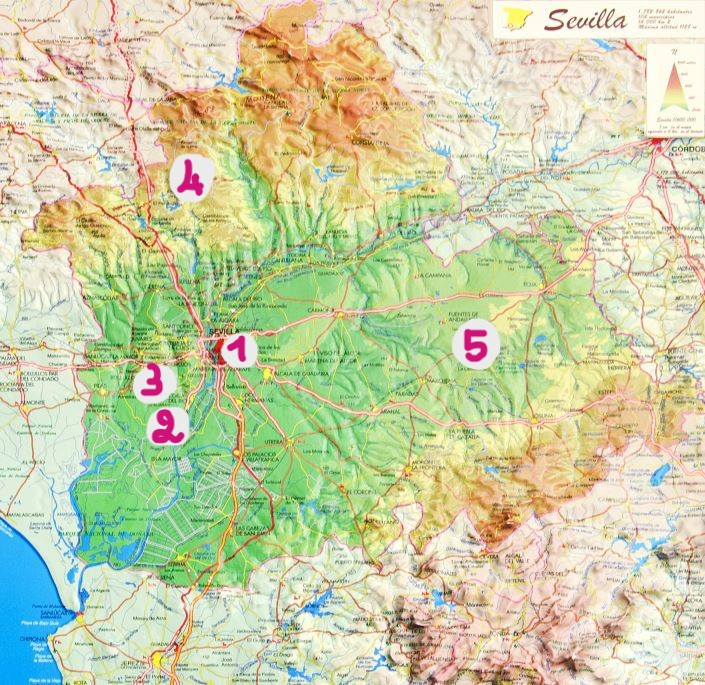
Seville’s privileged location, connected to extensive natural areas, provides the city with an exceptionally extensive bird list. It is possible to observe here almost all the regular species of the province, although with very different frequencies, from the common ones to rarities that find refuge in its green enclaves.
Maria Luisa Park
Among the main urban enclaves is the historic Maria Luisa Park and the Alcazar Gardens, an oasis for forest and insectivorous passerines where the Hoopoe roams the meadows, the Cetti’s warbler sings from the thicket and bustling flocks of Monk Parakeet and Rose-ringed Parakeet nest in the palm trees.
Guadalquivir docks
The banks of the Guadalquivir and its docks form a corridor of aquatic and marsh habitat in the heart of the city center. From its banks it is easy to spot the Kingfisher lurking in perches, the Little Egret fishing on the shore and, during the winter, the Great White Cormorant. In the migratory seasons, the sky is filled with Barn Swallows and House Martins.
Alamillo Park
Due to its great extension and its lagoons, the Alamillo Park is the best peri-urban enclave for the observation of aquatic birds. In addition to the most common species, specialties such as the Ferruginous Duck(Aythya nyroca), the Common Coot (Fulica cristata) or the Little Bittern (Ixobrychus minutus) can be detected throughout the year. The characteristic drumming of the Iberian Green Woodpecker resounds in its mature trees.
Historic center of Seville
The sky over the historic center is the domain of aerial urban birds. Common Swifts and Pallid Swifts – more easily distinguished by their high-pitched calls – circle over the rooftops. As a curiosity, the Giralda and other monuments serve as a winter roost for the Lesser Kestrel, a small migratory bird of prey that has found a unique refuge here.
Guadaíra River
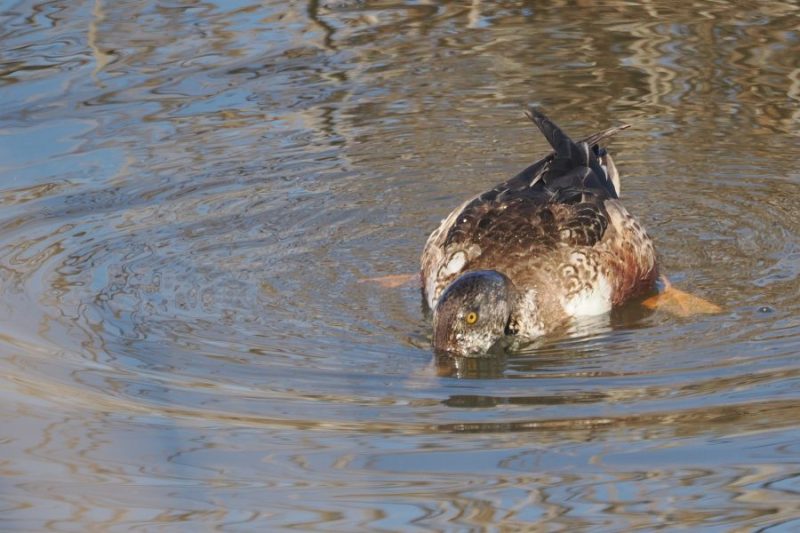
Finally, on the southern periphery, the Guadaíra river and its adjacent agricultural areas offer large areas to explore. This local hotspot, accessible by bus (lines 37 and A6), is frequented by raptors such as the Black Kite or Booted Eagle, and hosts a remarkable concentration of herons and ducks, such as the Northern Shoveler. The riparian thickets are the territory of shrikes and warblers.
This amazing diversity makes Seville one of the European capitals with the greatest potential for urban birdwatching, where a simple stroll can yield encounters as varied as they are unexpected.
The data is revealing: seventeen of the twenty richest ornithological hotspots in the province of Seville are concentrated in the environment of Doñana. This is not a coincidence, but the proof that less than an hour from the capital opens one of the doors to the most valuable biodiversity in Europe. Far from being a homogeneous wetland, Doñana is presented here as a mosaic of intertwined ecosystems -lagoons, crops and Mediterranean scrub- where each one tells an essential part of the story and hosts a different bird community.
The Lagoon System
This group of temporary freshwater or brackish water lagoons is the ornithological heart of the area. They act as magnets for aquatic birds, especially during migration and wintering. Here it is easy to observe the elegant Avocet (Recurvirostra avosetta) and the Black-winged Stilt (Himantopus himantopus) on the banks. The lagoons are a crucial refuge for globally threatened species such as the White headed Duck (Oxyura leucocephala) and theMarmaronetta angustirostris (Marmaronetta angustirostris). Marsh Harrier (Circus aeruginosus) patrols over them, and with luck, the elusive Little Bittern (Ixobrychus minutus) can be spotted among the reeds.
Agricultural Crops
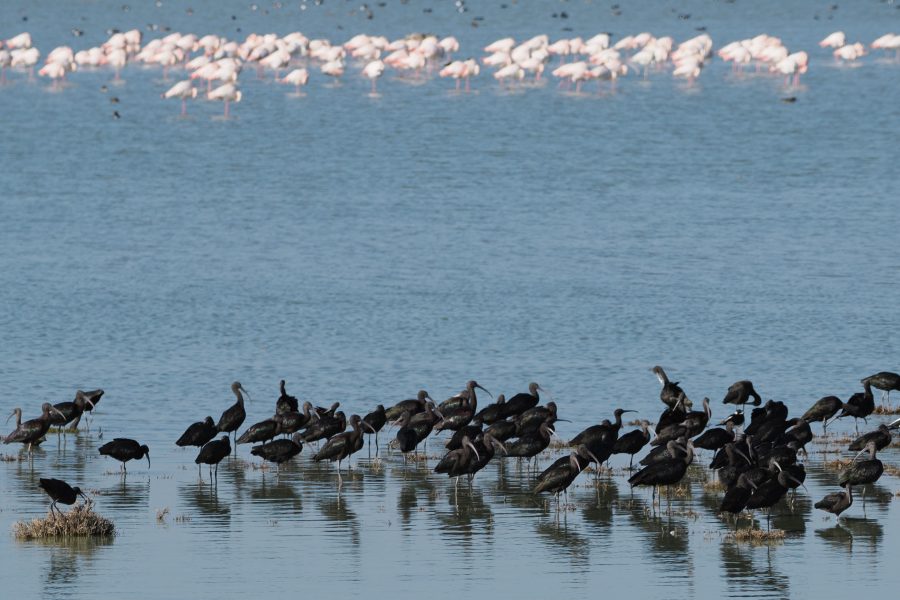
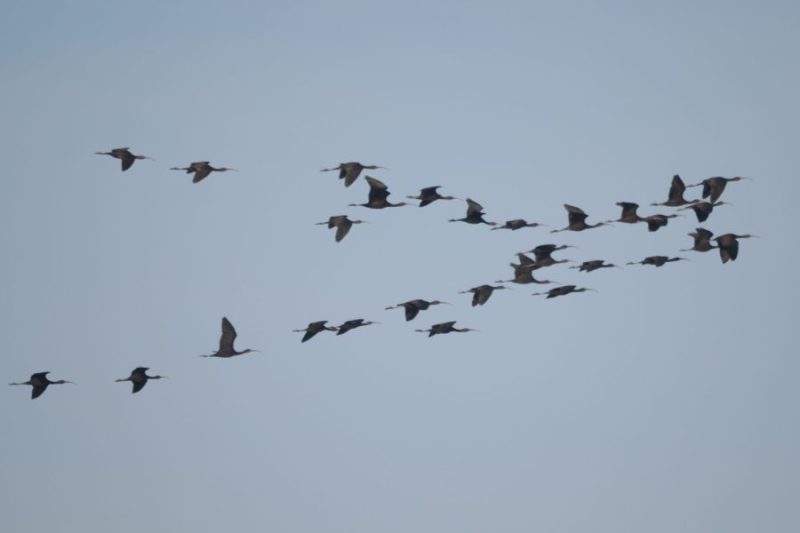
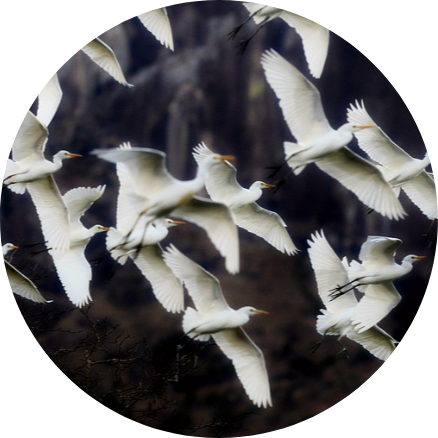
The extensive rice fields and crop fields are not only productive ground for humans; they are the feeding ground and seasonal refuge for thousands of birds such as the huge flocks of Glossy Ibis (Plegadis falcinellus), Cattle Egrets and White Storks. This open landscape is the hunting ground for specialized birds of prey: the Montagu’s Harrier ploughs through the crops in summer, and the elegant Red Kite in winter, demonstrating how traditional agricultural activity can sustain an exceptionally rich ecological cycle.
The Mediterranean Peripheral Mount
North of the marshes, the landscape transforms into a dense matrix of pine forests, tall scrub and heathland, a world apart. This is the domain of the most iconic forest birds of prey. The superb flight of the Spanish Imperial Eagle dominates the heights, and the shimmering white of the Black-shouldered Kite cuts the sky at dusk. The forest resounds with the chattering of the Azure-winged Magpie and the distinctive drumming of the Azure-winged Magpie. The thick scrub provides critical habitat for forest species such as various warblers (Sylvia spp.). Finally, the presence of the feline completes the feeling of being in a wild and complete ecosystem.
Beyond the spectacle of birds, the Mediterranean mountain of Doñana guards its most emblematic inhabitant: the Iberian lynx (Lynx pardinus), the most endangered feline on the planet and a living symbol of conservation success. Its existence, once on the brink of extinction, is intimately dependent on dense populations of the European rabbit (Oryctolagus cuniculus), making its presence the most reliable barometer of ecosystem health. As a top predator with crepuscular habits, its activity structures the community around it through a fundamental ecological phenomenon: the “trophic cascade”, which regulates the populations of other carnivores and herbivores.
Although their direct observation remains a challenge due to their cryptic behavior, their influence is palpable in the territory. A clear example of this is the Pinares de Aznalcázar, located in the area of Doñana, which today constitutes the nucleus with the highest density of lynx in the province of Seville. This success is not accidental, but the direct result of optimal ecological conditions and active conservation management. The habitat, a mosaic of stone pine (Pinus pinea), well-structured Mediterranean scrub and patches of scrubland, provides the feline with the shelter, cover and, above all, a stable abundance of prey necessary for its survival and expansion. This space thus stands as a concrete testimony of how science and management can reverse the trend of a species, offering a privileged window to understand its role in the bush.
The Sierra Morena of Seville, embedded in the north of the province, represents the most extensive and rugged expression of Mediterranean forest and scrub in the community. This vast territory, most of which has been declared a Natural Park, is a succession of hills, valleys, open pastures and dense forests of Quercine trees that create a refuge of important biodiversity. Its avifauna is dominated by forest species, rupicolous and those adapted to pasture landscapes, constituting the main bastion for large birds of prey and a community of passerines unique in the region.
The sky of Sierra Morena is, indisputably, the kingdom of raptors. Its rocky cliffs and extensive territories offer the perfect habitat for some of the most endangered and emblematic birds of prey in Europe. It is the domain of the Black Vulture (Aegypius monachus), which has here one of its largest breeding colonies in the world, and the Spanish Imperial Eagle (Aquila adalberti), which finds in these mountains a crucial home range. The Golden Eagle (Aquila chrysaetos), the Bonelli’s Eagle (Aquila fasciata) and the Egyptian Vulture (Neophron percnopterus) share the heights, forming a community of large winged predators of exceptional richness.
Under this canopy of raptors, the Mediterranean forest and scrubland is home to a dense and specialized community of forest birds. The thickets are the territory of the Ghoshawk (Accipiter gentilis) and the Sparrowhawk (Accipiter nisus). The trunks of old cork oaks and gall oaks resonate with the drumming of the Iberian Woodpecker (Picus sharpei) and the Great Sp . Woodpecker (Dendrocopos major). Among the thicket, warblers – such as the Dartford warbler (Sylvia undata) and the Sardinian Warbler(Sylvia melanocephala) – are ubiquitous, while the Iberian Azure-winged Magpie (Cyanopica cooki) contributes its characteristic bustle. In the clear pastures, the Hoopoe (Upupa epops) and the Red-legged Partridge (Alectoris rufa) are common species.
In the agricultural heart of the province, between the countryside of Osuna and Ecija, extends a sea of cereal and olive groves that forms one of the last pseudo-steppe landscapes of southern Spain. This apparently monotonous habitat is actually an ecosystem of the highest conservation value, sustained by traditional dry farming practices. Far from forests and wetlands, its avifauna is composed of species specialized in living in open, horizontal spaces with little cover, many of which are among the most endangered in Europe due to agricultural intensification.
This open landscape is the realm of steppe birds, authentic jewels of the Iberian avifauna. The Great Bustard (Otis tarda), the heaviest flying bird in the world, has its main leks or courtship areas here. The Little Bustard (Tetrax tetrax), smaller and more cryptic, performs its spectacular nuptial flights over the stubble. Other key species are the Pin-tailed Sandgrouse (Pterocles orientalis) and the Iberian Sandgrouse (Pterocles alchata), adapted to obtaining water from seeds, and the Stone Curlew (Burhinus oedicnemus), with nocturnal habits and a shrill call.
Plains raptors find their ideal hunting grounds in these expanses. The Montagu’s Harrier (Circus pygargus), which nests directly in cereal crops, is the most emblematic and vulnerable. It is accompanied by the Lesser Kestrel (Falco naumanni), which nests in the historic buildings of villages and farmhouses, and the Black-shouldered Kite (Elanus caeruleus), a small raptor with striking white and gray plumage. During the winter, the Hen Harrier (Circus cyaneus) and the Merlin (Falco columbarius) are added.
The diversity is completed with passerines and other birds adapted to the borders, fallows and small patches of scrubland. The Calandra Lark (Melanocorypha calandra) and the Crested Lark (Galerida cristata) are common voices. The Great-spotted Cuckoo (Clamator glandarius), a parasitic bird that lays its eggs in Magpie nests, and the spectacularly turquoise-blue European Roller (Coracias garrulus) add notes of summer color and exoticism. The conservation of this traditional agricultural landscape is crucial to the survival of this unique community, making these steppes a prime ornithological destination to observe some of the most urgent and fascinating ecological dramas of the peninsula.
Bird flocks in Doñana
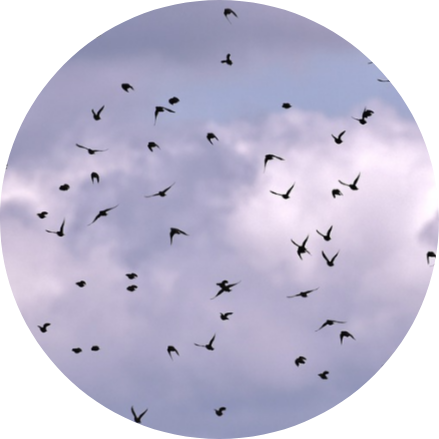
Bird assemblages are one of the most visible and awe-inspiring natural spectacles, especially in the transformed marshes (“polders”) of the Brazo del Este, where the concentration of food and aquatic habitat attracts thousands of individuals.
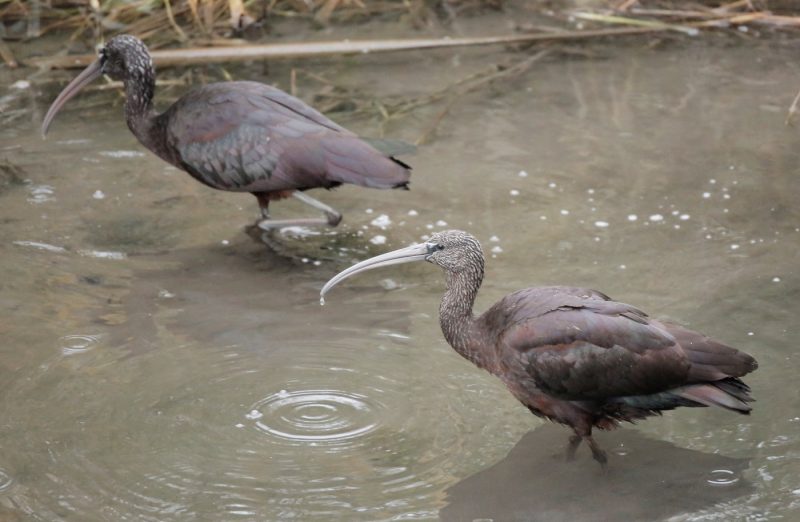
This spectacle is unique in the European continent and are one of the reasons that give worldwide fame to Doñana. The outskirts of Seville are perhaps one of the most favorable places for these impressive sightings, especially after the rice harvest.
These flocking phenomena can be classified into three main ecological categories, each with its own dynamics, species and time of year, revealing the crucial role of this area as a node of life for European avifauna. These are 1. Colonial birds. Migratory birds. 3. Wintering waterfowl.
ICONIC WATERBIRDS
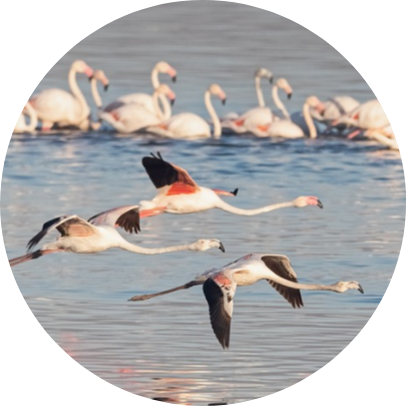
> 75,000

> 5.000

> 10,000

> 15,000

> 0.000
1. Colonial Birds: Roosts and Breeding Colonies
The roosts are mainly of resident or wintering species that seek nocturnal security in winter. Of particular note are the large roosts of Cattle Egret (Bubulcus ibis) and Spotless Starling (Sturnus unicolor), which can congregate thousands of birds in reed beds. The breeding colonies are the heart of the breeding population, with mixed colonies where Little Egret (Egretta garzetta), Spoonbill (Platalea leucorodia) and Night Heron (Nycticorax nycticorax) nest, the latter a non-resident bird that arrives in spring and leaves in autumn.
DUCKS AND WADERS

> 90,000

> 50,000

> 40.000

> 0.000
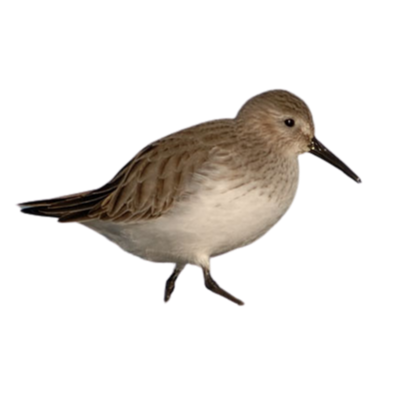
> 40.000
2. Birds in Passage: Migratory Concentrations
The wetlands provide food for migrating birds in spring (March-May) and autumn (August-October), when there are spectacular concentrations of birds that are not in Doñana to winter or breed, but to rest and feed before continuing their journey. This includes:
- Massive passages of Barn Swallows (Hirundo rustica), House Martins (Delichon urbicum) and Common Swifts (Apus apus).
- Groupings of waders such as Sandpipers (Calidris spp.) and Skanks (Tringa spp.) on muddy banks.
- Concentrations of birds of prey such as the Marsh Harrier (Circus aeruginosus) that use the area as a premigration area.
AND OTHER SPECIES
> 0.000

> 0.000

> 20,000

> 0.000
> 0.000
3. The Wintering of Waterfowl
It is the most massive and characteristic aggregation phenomenon, which occurs from November to February. Tens of thousands of birds from northern Europe choose Doñana as their winter quarters, transforming the landscape. The most notorious flocks are:
- Anatidae: Flocks of Shovelers (Spatula clypeata), Pintails (Anas acuta) and Wigeons (Mareca penelope).
- Greylag geese (Anser anser): They form large groups that graze on the shore and marshes.
- White Storks (Ciconia ciconia): with a complex migratory pattern.

In conclusion
The city of Seville is the strategic and multifaceted base camp to complete a trip to Andalusia(city tour) with days dedicated to ornithology. Its position allows access from the capital to an amazing diversity.
The marshes and preparques of Doñana for waterfowl; the steppe countryside of Osuna and Ecija for Great Bustards and Little Bustards; the endorheic lagoons such as Fuente de Piedra for hollyhocks and Greater Greater Flamingoes; and the Sierra Morena for forest birds of prey and the imperial eagle. In addition, the city of Seville itself is home to a remarkable urban avifauna in its monuments along the Guadalquivir corridor.
Leave a Reply