


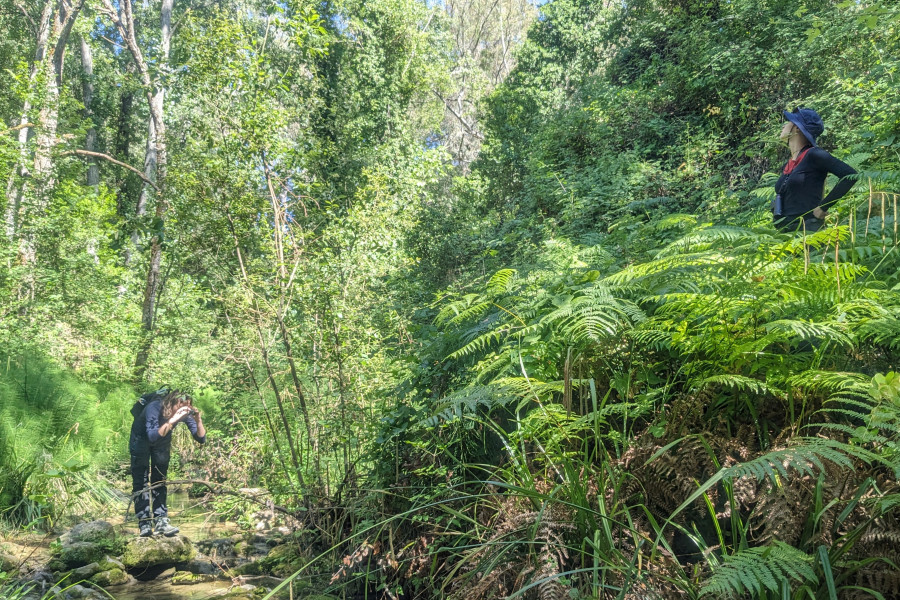
The observation of insects, butterflies, dragonflies and damselflies or grasshoppers, among others, is undergoing a paradigm shift from traditional entomological net-catching to non-invasive identification, following the path opened by birdwatching.
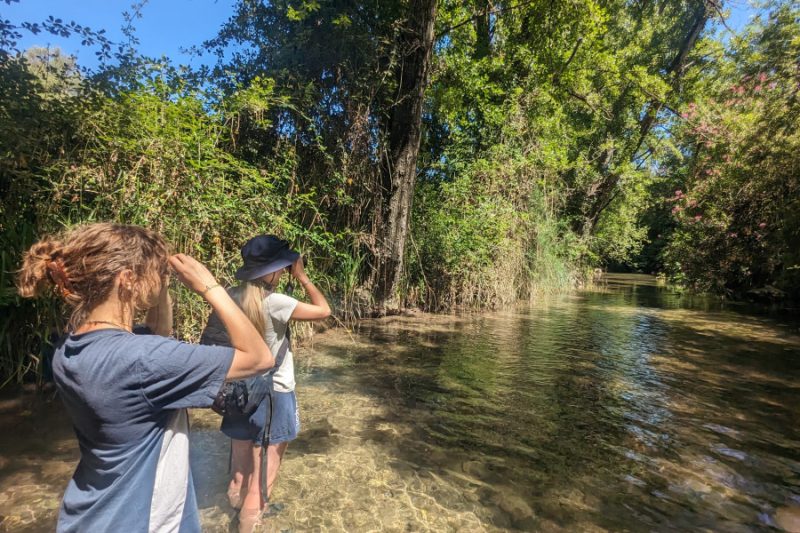
Nature observers spotting dragonflies in the Majaceite river. June 2024 – El Bosque.
Following the rise of digital photography, the pure observation of insects is experiencing a great development, giving priority to aesthetic and contemplative enjoyment in the natural environment. This practice also renews the scientific field since it allows to easily count the abundance of individuals and to study their behavior in the field.
| Model | Min. focus (meters) | Field of vision | Rotation Focus (degrees) | Weight (grams) | Price approx. | Global Commentary |
|---|---|---|---|---|---|---|
| Pentax Papilio III WR 8.5×21 | 0.5 m | 105 m | ~120° | ~ 300 g | 150-200 € | Pioneer. Minimum distance. |
| Zeiss Victory SFL 10×40 | 1.5 m | 115 m | ~180° | ~ 600 g | 1 800 € | Premium ultra-lightweight |
| Kite Falco 10×42 | 1.7 m | 114 m | ~300° | ~ 700 g | 300-450 € | Good choice x10 |
| Vortex Viper HD 8×42 | 1.5 m | 130 m | ~360° | ~ 650 g | 500-700 € | Best option x8 |
| Vortex Diamondback HD 8×42 | 1.5 m | 131 m | ~360° | ~ 620 g | 250-350 € | Good value for money entry |
SUMMARY TABLE WITH MODELS DESIGNED FOR INSECT OBSERVATION. Min. focus Nearest distance (in meters) at which the binocular focuses sharply. Field of View: Width (in meters) of the view visible at 1 km distance. Focusing Rotation: Degrees of rotation of the central ring to go from minimum to infinity. Weight: Total mass in grams.
Direct observation facilitates rapid identifications in regions where the fauna is well known tahnks to visual identification guides. This has been made possible thanks to a new generation of modern binoculars with very short distance focus, ideal for examining morphological details (wings, abdomen, eyes) without frightening the insect, transforming field entomology into an accessible and dynamic activity.
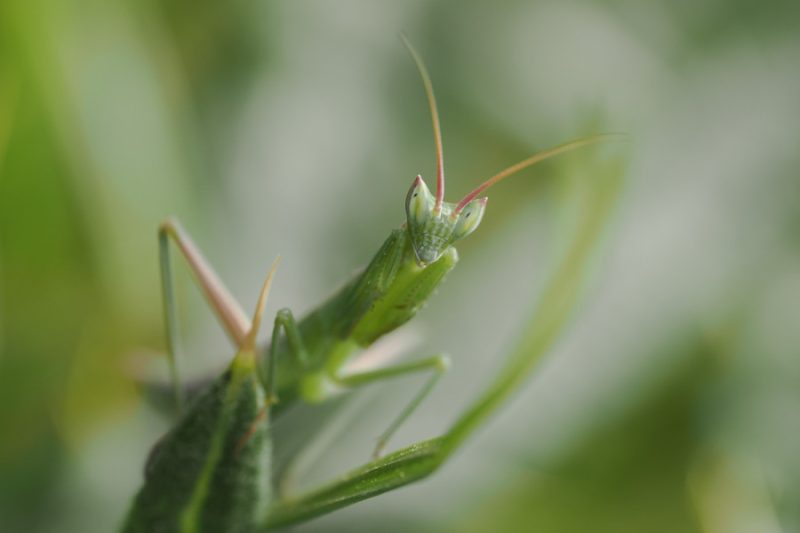
Apteromantis aptera (Fuente, 1894). A very inconspicuous spring Mantodea with striking eyes. April 2026 – Sierra de Caramolos, Villanueva del Rosario.
Parameters to consider when observing insects in the field
MINIMUM FOCUSING DISTANCE: For observation of large insects (say > 5mm), a distance of less than 2 meters (often 0.5-1.5 m) allows you to get close enough to perched insects to identify key morphological details without disturbing them, preventing them from fleeing due to disturbances such as vibrations or shadows.
FIELD OF VISION: A wide FOV (>115 m/1000 m) is essential in odonatology because dragonflies are fast and maneuverable in flight; it makes it easier to track erratic trajectories or migrating groups without losing them at the edges of the visual frame.
FOCUS ROTATION: A short rotation (<200°) makes it quicker to switch between study subjects perched in close proximity, e.g. a perched dragonfly, in need of close focus, and distant subjects such as birds or other insects in flight during mixed surveys. A “short” wheel reduces time wasted on manual adjustments in dynamic field and fatigue.
WEIGHT: Binoculars under 700 g minimize fatigue on prolonged hikes, allowing sessions of several hours without neck or arm pain, key for naturalists, or river wading.
For detailed observation of insects in the field, it is crucial to select binoculars with a focusing distance of less than two meters, a wide field of view (>115 m/1000 m) and a fast swivel.
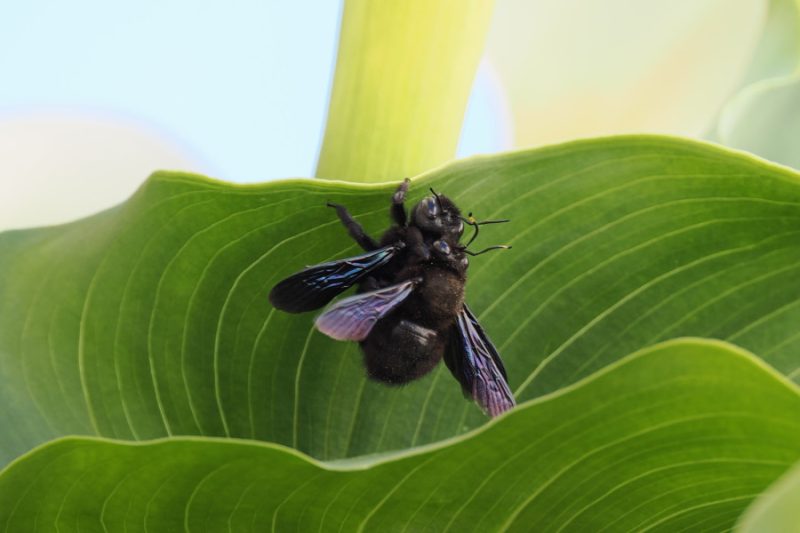
Xylocopa violacea (Linnaeus, 1758). An uncommon image of the copulation of these carpenter bees perched on a leaf of the ornamental arum Zantedeschia aethiopica. April 2026 – Benarrabá.
The original Pentax Papilio appeared on the market in November 2004.
It was a truly visionary model that changed the rules of the game: its name, Papilio (Latin for butterfly), already declared its purpose, as it was designed specifically for close observation of butterflies and large insects, a niche that no other brand had seriously considered until then. The key innovation that made it a pioneer was its objective convergence mechanism, which corrected image misalignment (parallax) at close range, allowing binocular sharp focus at just 50 centimeters. For a very cheap price, it offered something that seemed impossible: it was like looking through a live microscope without having to capture the insect; a completely new experience for nature observers, who could discover details such as the ocelli of a butterfly or the wing veins of a dragonfly without the animal fleeing.
In its virtue lay its limitation. It was not, nor was it intended to be, a binocular for ornithology and traditional observation, with its very small field of view (barely 105 meters at 1 km), small exit pupil (2.4 mm) that renders it useless in shade or at dusk, and total lack of waterproofing against moisture or dust. After the conceptual success of the Papilio, the manufacturers of high-end binoculars got the message: the nature observer was no longer satisfied with seeing only the horizon, (s)he also wanted to resolve close detail. Thus, the last few years have seen a breakthrough: several premium 42 mm models have succeeded in lowering their minimum focusing distance to the 2-3 meter range, something unthinkable a decade ago in optics of that caliber. They make these instruments truly multi-purpose tools with close focusing on high-luminosity bodies. They make it possible to go from observing butterflies or dragonflies at rest to following a bird of prey in flight a moment later.
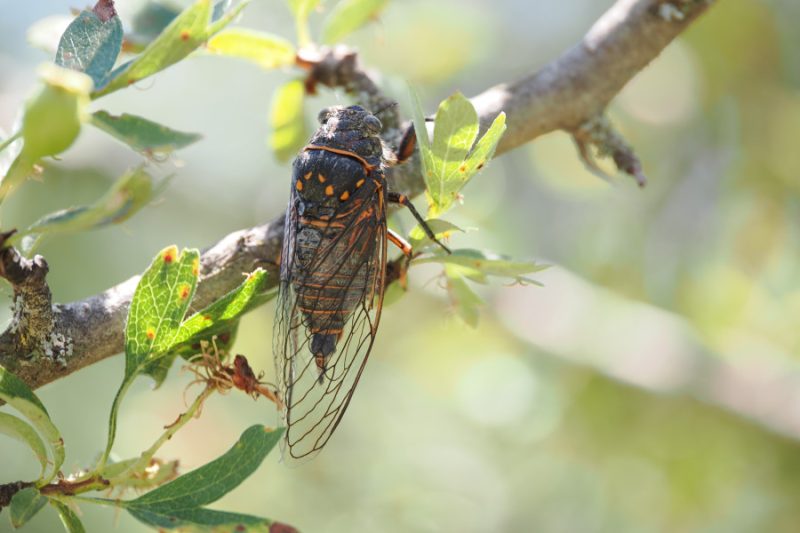
Tibicina spec. Kolenati, 1857. A very active and sound-producing male. July 2025 – Laguna de Uña, Serranía de Cuenca.
Zeiss SFL (“Smart Focus and Lightweight“) 10×40: Lightweight revolution in the premium league
Within the current panorama of high-end close-focus binoculars, the Zeiss Victory SFL 10×40 is the first model to combine the optical performance of a 42 mm with the weight and ergonomics of a compact 32 mm.
Its extraordinary lightness at just 640 grams, approximately 20% lighter than a conventional 42 mm. This weight reduction translates into less fatigue, greater pulse stability and a much more comfortable experience on long days. Its compact design makes it fit without discomfort.
On the optical side, the premium SFL 10×40 sacrifices nothing. Its lens system and anti-reflective coatings ensure a bright, contrasty and true-to-color image, even in difficult light conditions. Its field of view of 115 meters at 1,000 meters is generous and allows you to switch to birding with ease.
Its minimum focusing distance of only 1.5 meters deserves special mention, which places the SFL among the elite of all-purpose binoculars. Herein lies a subtle but decisive advantage over the Papilio: the 10x does not need to be approached as close. The SFL offers generous magnification at the perfect viewing distance. That 1.5 meters is just the threshold where most dragonflies, butterflies or grasshoppers remain quiet. We see bigger, but from farther away; critical morphological detail is revealed without the animal taking flight.
Finally, the premium quality is evident in its magnesium construction, sealed and nitrogen purged, guaranteeing total water and fog tightness, while the coating actively repels dust, fingerprints and splashes.
In short, the Zeiss SFL 10×40 has been an incredible discovery… An instrument capable of resolving both close insect detail and distant birding with excellence.
The SFL 10×40 price is a very big disadvantage for many observers. Therefore, we have selected binocular models with slightly lower but really good performance to start with: Kite Falco 10×42, Vortex Viper HD 8×42 and Vortex Diamondback HD 8×42. The latter model tested by us with very good performance.
G3-guides is independent and does not maintain any commercial relationship with the brands.
Leave a Reply