


The Iberian lynx(Lynx pardinus) is the most emblematic animal in Spain and Portugal, a symbol of wild nature, Mediterranean terrestrial ecosystems and nature conservation. What a beautiful animal!

The resurrection of the phoenix
In the early 2000s, the species reached its worst situation with less than a hundred individuals surviving in only two parks: the famous Coto de Doñana and the Sierra de Andújar, then largely ignored. At that time, the Iberian lynx was the most endangered feline in the world, despite being protected and present in a developed western country. Subsequently, several LIFE projects initiated an in situ ( mainly to promote wild rabbits) and ex situ (captive breeding program) conservation program. It is important to recognize that the Spanish workers worked very hard and were subjected to a “honcho” type of management… But well, …
The species survived! And today we can all benefit from the successes of the lynx conservation programme.

Nowadays, the lynx can be seen in the wild with relative ease. In Andújar, in winter, lynx are sighted on a daily basis. Observers and photographers join tours organised by local guides and sightings are very common. Unlike other lynx species, the Iberian breed is much less shy. The news shocked Spanish nature lovers when Quercus, the influential naturalist magazine, published an article entitled ‘The lynx is easily spotted’. Does this mean you will definitely see the animal? Of course not…
Where to look for the Iberian Lynx in Spain and Portugal?
Andalusia has served as a refuge for the Iberian lynx in Spain during the last decades, especially when the species was on the verge of extinction with less than 100 specimens detected in the early 2000s. These areas are considered the best for Spain’s large emblematic fauna, particularly mammals and carnivores. The best known is none other than Doñana National Park, one of the largest coastal protected areas in Europe and where most of the pioneering studies on the lynx have been carried out. The population of the feline has recently expanded in the nearby region of Aljarafe. The second traditional refuge of the nailed cat is Sierra Morena Central, specifically in the Natural Parks of the Andújar and Cardeña mountain ranges, whose private reserves have preserved a high degree of naturalness.
The Sierra de Andújar is widely recognised as the best place to go on an Iberian lynx safari and more and more visitors come every year to observe the cat.

By the year 2000, the Sierra de Andújar was already popular, but mostly with local nature watchers. Since then, the attraction has grown throughout Spain and Europe and even private estates dedicated to lynx watching have begun to flourish.
Best time of the year for a lynx safari in Andalusia
The winter months show a peak in lynx sightings in Andalusia with up to four times more sightings than during the rest of the year. The period from December to February coincides with the rutting season, when social interactions are at their peak and the optimal weather conditions, with no heat, favour the animals’ diurnal activities. The wild rabbits are also very active and the large raptors often display their courtship in the sky.
Although the strong winter season is clear, it is worth visiting at other interesting and successful times of the year.

Evolution of the world population of the Iberian lynx (Lynx pardinus)
The recent evolution of Iberian lynx populations has been very positive in recent years, with a spectacular increase in numbers since 2015.
Although the lynx is no longer Critically Endangered, it is still a ‘very’ Vulnerable species.
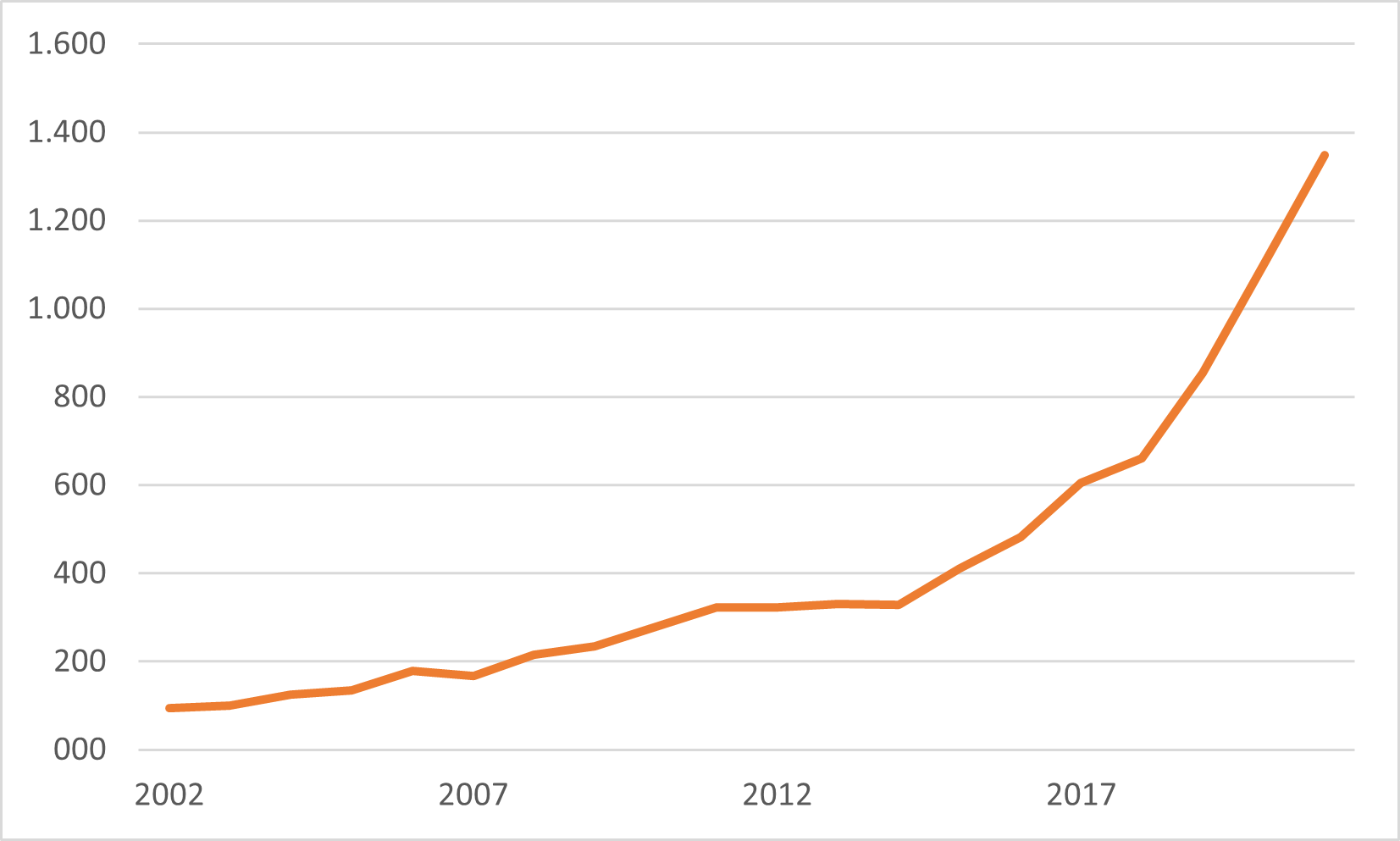
This overall figure has to be balanced by looking closely at the situation in the previous disputes of the species in Andalusia: the population of Doñana-Aljarafe remains very low (<100 individuals), especially in the National Park where the European rabbit has strongly declined while the population of Andújar-Cardeña has stabilized around 200 individuals for more than 10 years. Population gains have occurred through reintroduction programs in Sierra Morena(Guadalmellato, Guarrizas, Castilla La Mancha) and outside this mountain range such as Matachel (Extremadura), Montes de Toledo (Castilla La Mancha) and Guadiana (Portugal).
Behavior
The behaviour of the Iberian lynx differs to some extent from its European brother (Lynx lynx). Observing the feline in Andalusia revolutionises our perception of large carnivores… You may want to discover all the following information for yourself on the ground rather than reading it on a website. Please consider this emotion before reading further.
Of course, nothing is guaranteed, and only a patient and repeat observer will be able to confirm these assertions.
In general, it is very difficult to observe large carnivores in the wild in Europe.
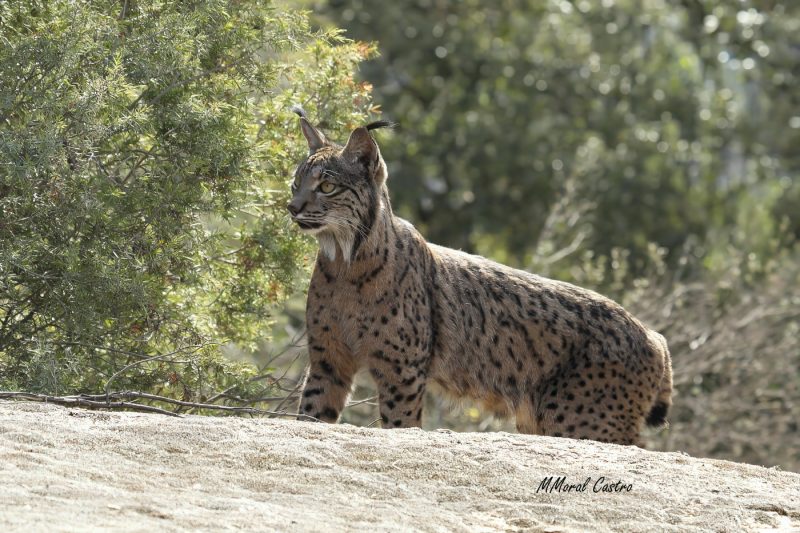
Diurnal activity is common in winter… or rather, outside the very hot and long summer season, when the feline spends most of the day resting in deep shade. From December to February temperatures are low and the rutting season takes place, which means a considerable increase in breeding observations and activities. Not surprisingly, winter is the peak season for lynx safaris in Andalusia.
It has gradually become accepted that the Iberian lynx is not totally solitary and exhibits social behaviour. A male, a female and two or three cubs or juveniles are regularly seen together. This is not common, but can be observed by regular observers. In the early 2000s, this situation was not well appreciated by scientists… which gives an idea of the extent of knowledge acquired in recent years thanks to the efforts of the whole ‘Iberian Lynx community’ (scientists, ecologists, landowners and enthusiasts).
The Iberian lynx is not overly fearful of friendly humans, living up to its status as the super-predator of the Mediterranean forest. Today, in long-established territories, the sense of threat from humans must be low, given the slow pace of the felines in the field. In fact, lynxes and observers regularly look at each other, aware of each other.
Their territory is often located on large private estates with regular human activities. Conservation programmes have also led to an increase in human presence in some of these areas over several generations. Despite the initial reluctance of authorities and landowners more than 20 years ago, many observers and photographers seek out the lynx… Although it is difficult to assess, we believe that today the big cats, if left undisturbed, are becoming accustomed to the respect of humans. And if this were not the case, most of the observations would be of individuals on the run.
As a general result, observations often last more than a few minutes. Which is incredible considering the behaviour of large carnivores in general and such a rare animal in particular. Isn’t it exciting to think that such a persecuted species is now so valued and loved by so many people? And these lynx live in a naturally ‘relaxed’ way.
Leave a Reply