


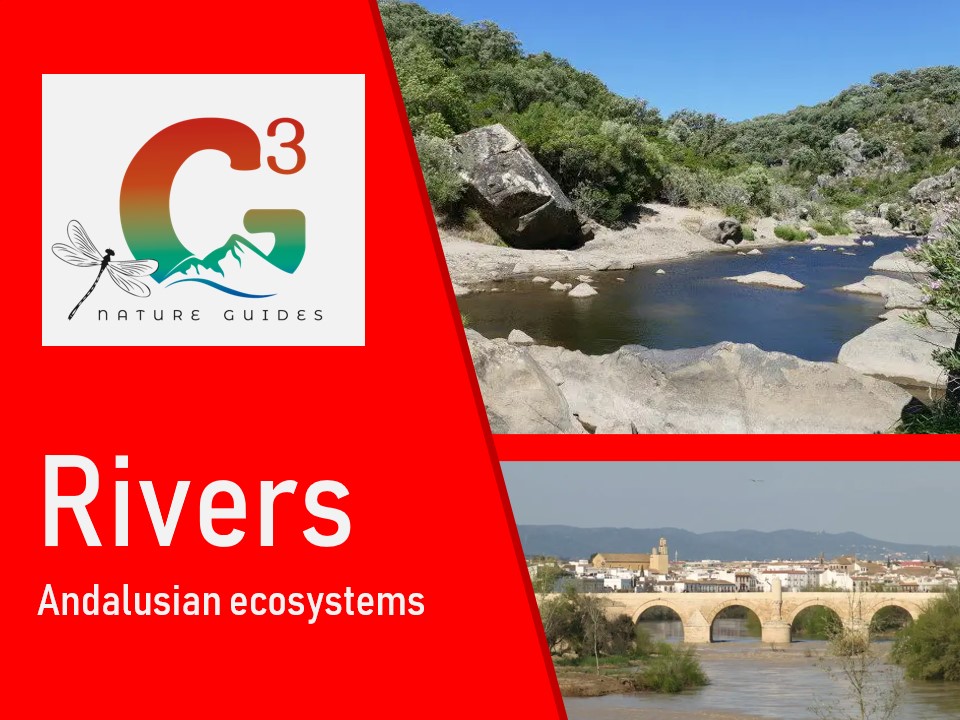
A network that connects territories and carries the source of life and biodiversity.

The hydrographic network of Andalusia is mainly organized around the depression of the Guadalquivir river that flows into the Atlantic Ocean. Curiously, there is some controversy about the location of the source of this river, officially located in the Sierra de Cazorla (Jaén). Its main tributaries are the
Guadiana Menor, Genil and Guadalimar rivers . TheAtlantic basin also receives theGuadiana river , which flows to the north of Andalusia and borders Portugal, and theOdiel, Guadalete and Barbate rivers . The Mediterranean basin has shorter rivers: Guadiaro, Guadalhorce, Guadalfeo, Andarax, Almanzora and Segura.
Andalusia is characterized by a semi-arid Mediterranean climate that causes a strong evaporation of water (low water) in the middle and upper reaches. Our region is distinguished by the numerical importance of temporary streams and wadis (the latter only drain rainwater). Even so, the lower reaches of the main rivers are permanent.

To highlight the omnipresence of reservoirs built throughout the hydrographic network and where invasive allochthonous fish thrive.
The rivers, water in movement… Gushing in the springs; lit by the rocks and gallant of the mountains; fine threads that run between rocks and forests; bed of insects and winged nymphs; joy of summer; path that takes strength and breadth after the rains; solemn masses of water, calm but ready to overflow; they rush towards the sea without fatality; they engender marshes and estuaries; they nourish the sea. … Sources of life.

The Guadiaro basin, with the rivers Genal and Hozgarganta; several streams of the Costa del Sol; the Pedroches stream near the city of Cordoba, and some others, stand out especially for their naturalness and biological interest. Mention an extraordinary river, the

To highlight the native fish, many of them endemic and adapted to the conditions of the temporary streams; the benthic invertebrates that are bioindicators of water quality; the dragonflies of flowing waters, very abundant in the middle reaches, although the interesting pale gonphus(Onychogomphus costae) appears mainly in the lower reaches. Among the vertebrates,

2007: a full year of aquatic insect surveys (+200 field days) in the best and worst streams of Andalusia.
Wells in temporary Mediterranean rivers

During the summer period, a drying phase characterizes the middle streams and headwaters of Mediterranean rivers and streams. The deepest and most impermeable areas of the minor bed retain water and form basins, true oases for aquatic fauna and flora.
Leave a Reply