

This January 2025 followed its course under the sign of the feline that has been the most endangered in the world not so long ago, with less than 100 specimens in 2000. We were lucky enough to spend long days in the Andújar mountain range.

Friday 3. We arrived in Andújar (Andalusia) and started our season in this, already mythical, Sierra Morena in the hope of spotting as many lynxes as possible. Soon, granite boulders and holm oaks cover the landscape. We go straight to the point, heading for Los Escoriales. On the route, we enjoy good numbers of deer (Cervus elaphus hispanicus), Fallow deer (Dama dama), European Moufflon (Ovis orientalis musimon) and soon mountain goats (Capra pyrenaica hispanica).[1]). It is difficult to find another place with such a large number of large herbivores. It is a joy… although perhaps the animals are too quiet for lack of the super predator that controls their populations.

On the rocky wall of La Lancha (toponym referring to a rather large stone), a coiled and lazy fox (Vulpes vulpes silacea) enjoys a long rest under a weak sun.
In the meadow of the Casa de Madroñalejo, today abandoned, we witness an unusual gathering of birds: an imperial eagle(Aquila adalberti) seems to receive the ailments of a pair of black vultures (Aegypius monachus), as many crows (Corvus corax) and a number of black starlings (Sturnus unicolor). Tired of so many complaints, the raptor takes flight and disappears behind the hills. At the end of the afternoon, we observe from a great distance a lynx (Lynx pardinus) that furtively strolls along a track of the Finca de los Escoriales… Not much time, but we are satisfied with this first observation of the real King of the Mediterranean bush.
Saturday 4. We will dedicate the day to Encinarejo, arriving early to take our place before the night fades. It is bitterly cold, with temperatures below -3ºC, but the reward is immense.

I had never observed such movement of Otters(Lutra lutra) and for such a long time.
Their ivory teeth contrast against the dark background. They glide among the stones with great agility. There is a lot of play in the water. The observation culminates with three heads emerging together in the same shot. Photo: Éric Petit.
The spectacle is amazing, with several individuals fishing together in the river Jándula.
An indelible image. In the distance, another pair of otters are moving away following the flow… The cold bites and it is time to escape. On the way, we meet a group of observers located in the observatory of Barranco de San Miguel but the lynx has just vanished.
The recently introduced bison (Bison bonasus) can be seen next to the Casa del Encinarejo Alto. After a refreshing coffee, we return to the same environment. On Cerro Torviscales, a pair of Cinereous Vultures (A. monachus) preen their feathers from a high rock. The shore of the reservoir allows us to rest from the small crowd in the recreational area. And we return to the Barranco. A Robin (Erithacus rubecula) approaches without fear, true to the custom of its species. Little activity, although an Imperial(A. adalberti) animates our wait.
Sunday 5. We set up early on the first crag of the La Lancha trail, also known as Curva de los Toros, to wait for both the lynx and some playful and undaunted Weasels (Mustela nivalis). A pity, but neither of them can be seen.
A dense fog thickens with the passage of time.
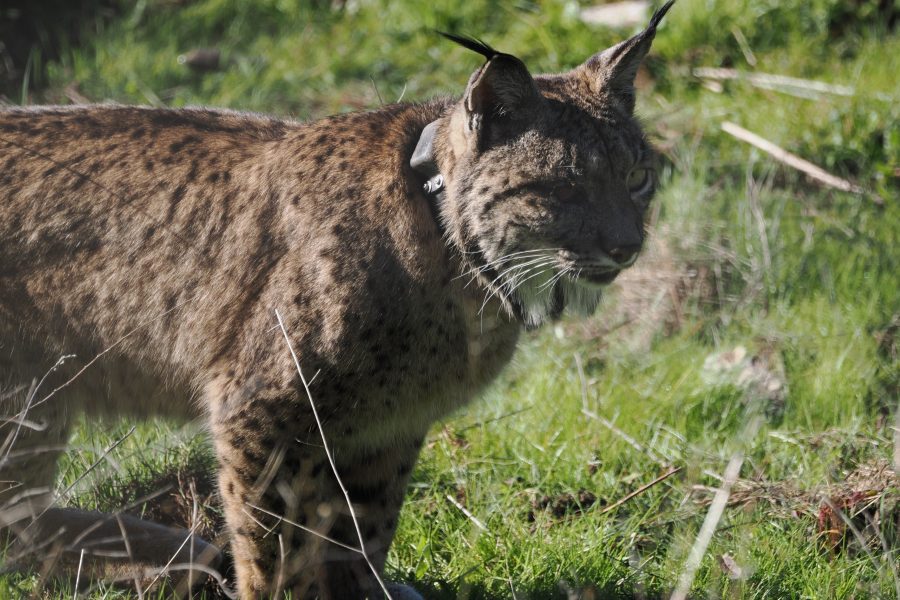
The short whistles of the Chaffinch (Fringilla coelebs), the crackle of the Peti (E. rubecula), the rattle of the Chaffinch(Turdus viscivorus) and the fluttery melody of the Blackbird (Turdus merula) follow one after the other. The holm oaks and granite bolondros are lost in the increasingly opaque fog. The night before, a local showed us a photo of a lynx next to a recently dead deer … We set out in search of the carrion. With little success. At least, we can contemplate the pasture and a beautiful berrocal (a granite chaos, in which there is a large amount of berruecos, bolones or caballeras stones). We move towards a viewpoint with wide views over the immense Batolito de los Pedroches as a backdrop. Majestic herbivores abound. But in general terms, the sierra is being very dry and the streams without water, not even a small pool for the salamanders(Salamandra salamandra morenica) that we will not be able to see. A few holm oaks are already blooming so early. In the afternoon, we return to Los Escoriales. After a wait, we join the band of observers gathered by the presence of a lynx (with collar) resting and cleaning itself very quietly. It soon disappears behind the Aire pass. It is time to say goodbye for the day.
Monday 6. Finally, the rains are arriving in the sierras and the rest of Andalusia.
Friday 10. Very long day. A lightning-fast Weasel (M. nivalis) appears and disappears among the rocks and stone walls bordering the trail. We move on and enjoy a large group of mountain goats (C. pyrenaica) quite confident and playful among the abandoned houses of the village. When we came down from the sierra, we saw how abundant the wild rabbits (Oryctolagus cuniculus) were among the olive groves near Andújar. At night, several midwife toads (Alytes cisternasii) respond to each other with their monotonous syllable.


Saturday 11. The otter (L. lutra) can only be seen in the distance along the Jándula river. A long day of waiting awaits us, with very little activity. Before nightfall, a pair of lynx put on a show, with a male resting and forming a large clear patch in a grassland covered with lavender. The lynx is visible to the naked eye (when one knows where to look), rests stretched out and calm, and finally cleans himself, before moving – the Magpies (Pica pica) harass the cat for a brief moment – heads into the thicket and gets lost behind a shrubby holm oak (Quercus ilex).


At the same time, the female is active, prances and misses the rabbit…. She seems to join the male for a moment. The camera bursts do not stop shooting. The female gets lost under a mastic tree (Pistacia lentiscus) a few meters away from the male, but we will not observe her anymore. In a very short time the felines made our day.

Sunday 12. A Garden dormouse(Eliomys quercinus) crosses the road. We witnessed a perfect sunrise over the Sierra Morena. After two cloudy days, it is sunny and very clear. In the background, a sea of slightly pinkish clouds extends to the foot of the sanctuary. Closer, the oaks and the granite bolondros receive the first rays of the sun.

The Iberian Green Woodpecker (Picus sharpei) laughs. The cold colors contrast beautifully in the shade and the warm ones in the light. The granite turns golden and the grayish trunks reflect the light generously. The passerines fill the meadow in their turn. Later in the day, we are very lucky with #Magarza#, the lynx of the collar that we will observe on two occasions. First, the feline follows for a long time a track next to a dry creek. A sometimes agitated fair of people is also on the move.

The second time, in the bush, very close to us, and looking for tranquility, quite alert due to the multiple noises, with hunting threats. How big is the nailed cat (Lynx pardinus) when it walks about ten meters away. In the shade of the mastic trees, it looks very beautiful with harmonious colors; in the light, its outline shines.

As the lynx sits within the very dark shade of a mastic tree, its white beards catch the eye from a distance.
Being a Sunday in January, the sierra is full of “nature lovers. A large troop is having fun with two Weasels (M. nivalis). Red-legged Partridges (Alectoris rufa), outrageous, have little fear. A majestic Fallow deer (D. dama) rests lying between rocks as in a movie scene. We finish at the Curva… wanting more, perhaps the lynx of the territory with her kitten. Today, no… Three rabbits (O. cuniculus) appear in the pasture, among the boulders, very attentive, often in an upright position, without moving for long periods… One of them is comical… it stretches out, rounding its back like a cat, and briefly shakes its body. I laugh at the scene.
Monday 13. Morning in the field followed by observations in the hides to take close-ups. Success, especially to ensure good images.
Tuesday 14. 7:30, -5ºC. The otter appears in the Jándula and climbs a rock on the bank before vanishing. After a while, another otter emerges from the dense branches of a willow tree very close to us. In its mouth, it carries something… at first it looks like a huge fish, perhaps a barbel or a Common carp…. but, no, it turns out to be a small otter that its genitor is carrying by mouth in the distance. Witnessing it seems unbelievable. At night, an impressive orange moon rises.
The following days(Wednesday 15 – Friday 17), the laudes allow us to repeatedly enjoy the spectacle of the otters. Classic” behaviors: repeated dives, nourished bubbles that show the aquatic trajectories, surface movements where you can see how they crawl using only the tail as a rudder, the chewing of prey, finishing quickly with crabs despite the rather hard carapace, the beautiful and funny interactions between individuals.

I am struck by new behaviors for me… on the one hand, an otter that lets itself float without hardly moving for long seconds, like a plank, and on the other hand, on the smooth and calm surface of the water, it suddenly emerges vertically, without warning, about 30 cm high, its snout pointing towards the sky, and it seems to look at the horizon as it descends.
On Thursday afternoon, we were finally able to observe deer (C. elaphus) in abundance in a previously unexplored area. It seems that they were concentrated.
The density of females was very surprising. The most interesting thing was to observe a large male browsing a holm oak: he stood up on his hind legs to gain height, using his antlers to tear off and carry a low branch to the ground, then he fed on the foliage. At dusk, we can observe a peak of activity next to the wild rabbits‘ perches. In another place and time, a compact and elusive pack of wild boars (Sus scrofa) appears, with adults and striped rabbits.


Friday, just as we reach the road to La Lancha, in the chaos of blocks next to the “curva de los toros”, not far from the Zarcejo marsh, which is not visible from the track, a well-known lynx, #Granza#, and her cub, become very discreet and hide behind granite balls. They are seen for a short time, but before disappearing, we observe the mother marking the territory insistently.


Saturday 18. The field is full of lynx enthusiasts during the weekend. Our camera traps have been successful, with a large number of wildlife such as rabbits, badgers (Meles meles),Azure-winged Magpie (Cyanopica cooki), and feral dogs appearing… A repeated and recognizable call announces the appearance of up to three imperial eagles (A. adalberti) when we are already descending from the sierra, harassed by a buzzard (Buteo buteo).
Monday 27. Heavy rain throughout Andalusia. Chorus of running toads (Bufo calamita) can be heard in the sierra at night.

Tuesday 28. A very unstable weather day. We found ourselves alone in El Encinarejo, ready to enjoy again with the mustelid. This time, we were treated to a morning that will remain engraved forever in my memory. At around 9:00, the first individual appears, from upstream, traveling a long stretch and passing the granite bar that serves as a promontory. As soon as it disappears, another otter follows with the same route, stopping on the shore to mark the terrain…


Again it gets lost in the widening of the river where we will observe them. In their roost, a troop of Great Cormorants(Phalacrocorax carbo) rests and endures the wet sky. At times, they are in a hurry and fertilize the river with their droppings… the water becomes richer and this may be attracting fish… There, their predators roam wide.
We observed a real otter dance, with a family group of three individuals. Two of them are together all the time, rubbing and sniffling. They dive into the water pushing the ground with their lower body. They are fun when they swim synchronously. The third otter occasionally joins in. The duo climbs over a dangling log, rubbing their bodies on the bark, and pacing in the tree. Very tenderly, a lying otter lets her partner rest her head on herself.
And again they jump into the water, it’s a back and forth of dives, fishing for silvery, shiny fish, most likely Bleak(Bleak alburnus alburnus) (no crab in this session), puddle crossers, they gather in a shore weedbed, again jumping into the water. A short distance away, the third individual is always present, gathering from time to time. It marks the stone near our shore, stretching the tip of its tail into the air. Amusingly and somewhat absurdly, when the otter comes out of the water on a rock, it shakes its whole body to get unwrinkled… and ipso facto throws itself back into the liquid element. After a good moment, enjoying with this very affectionate family, another pair of otters appears downstream… We don’t know where to look, when one otter disappears diving, another one is already in sight. The sight is shocking. Finally, one comes out into the grassland and begins to growl, opening its snout, as if waiting. Soon, another individual joins in, but this time the interaction is clearly negative. We hear repeated, loud, not particularly watery, but not unpleasant screeches, the cry of the otter. Here we observe a brief fight between these two. Their faces take on really impressive expressions – what a bitch! It lasts a few seconds, and each one returns to the water… the puddle seems to have been divided by an invisible border. We take advantage of a break from all this herd to leave and head towards our objective.

A Hoopoe (Upupa epos) joins a band of Azure-winged Magpies (C. cooki). At the moment, we observe a squirrel (Sciurus vulgaris), a very rare species in Sierra Morena. In the afternoon, a very strong and cold air blows. But once again we are lucky, and on the hill of the mountain, in a small meadow, next to a hollow formed by three granite stones, we observe an adult lynx lying down, its head resting on the cub of the year. After a while they get up and disappear. We spot them again in the same place and we can see from a distance (we are almost 1 km away) their walks through the bush until nightfall.


Wednesday 29th. The rain and the cold are curling up in Andújar, but it does not prevent good lynx observations in the hide.
Thursday 30. In the afternoon, in the Miradores de Los Escoriales. We can observe again a large amount of wildlife. Some rabbits stroll through the area. The ears completely turned back when they are grazing, very aware at all times of the dangers around them. Among the various herbaceous plants, one chooses to eat especially fennel (Foeniculum vulgare), a succulent dish for the lynx… We hear insistent meows (reminiscent of a cat in heat although they are very short). Soon we detect the lynx walking through the thicket at a great distance. He moves away and we confirm that it is a male. He gets lost in a crag near the pass. We take courage and take up our position on the track in front of the rocky hill… To our surprise, we discover the female in the territory instead of the male. It seems that this one went in search of her and maybe they got together for a moment. We observed #Magarza# for a long time on the hills of the road. He pauses like a real model next to a huge bolondro and even directs his (one-eyed) gaze at us. Her ears are very mobile. Although she is still, she doesn’t stop scrutinizing the environment. She disappears. After a while, we discover her, although almost only the tips of her ears are visible. She is eating a prey but we can’t see which one. The lynx’s walk continues. It is hunting. It can be seen jumping over an invisible prey. Perhaps the funny thing -if she were not one-eyed- is that the lynx passes within a short distance of a completely immobile rabbit in the bush. She doesn’t see it, she keeps moving forward… The lagomorph like a stone. Suddenly, it turns its head, sees it, jumps … and misses the attack.

Friday 31. Last day of January, … we do not observe the lynx this time, which reminds us that it is still the ghost of the Mediterranean mountain. We make a great review of the biodiversity of Sierra Morena, saying goodbye to each species and smelling the aromatic plants to take with us the essence of the mountain.
We have fun with the Little Owls and their various songs.[2]. The sunset accompanies our departure with a red horizon above the dark mountain range. At night, a roadkill and intact genet (Genetta genetta) sleeps forever and reminds us of the fragility of living beings.
Mammals of the Sierra de Andújar
| # | COMMON NAME | SCIENTIFIC NAME | NOTE | Jan-25 |
|---|---|---|---|---|
| 1 | Hare | Lepus granatensis | Iberian endemism | yes |
| 2 | European rabbit | Oryctolagus cuniculus | Key species | yes |
| 3 | Southern water vole | Arvicola sapidus | Located in Andalusia. Last meeting in Andújar 2006 | – |
| 4 | Mediterranean pine vole | Microtus duodecimcostatus | – | |
| 5 | Wood mouse | Apodemus sylvaticus | yes | |
| 6 | House mouse | Mus musculus | – | |
| 7 | Algerian mouse | Mus spretus | – | |
| 8 | Brown rat | Rattus norvegicus | – | |
| 9 | Black rat | Rattus rattus | Rare in Andalusia. Last meeting in Andújar 2006 | – |
| 10 | Red squirrel | Sciurus vulgaris | Rare in Sierra Morena | yes |
| 11 | Garden dormouse | Eliomys quercinus | yes | |
| 12 | Hedgehog | Erinaceus europaeus | – | |
| 13 | Greater white-toothed shrew | Crocidura russula | – | |
| 14 | Musarañita | Suncus etruscus | – | |
| 15 | Iberian mole | Talpa occidentalis | Iberian endemism. Important decline | – |
| 16 | European wildcat | Felis silvestris | Very strong decline in Andalusia | – |
| 17 | Lynx | Lynx pardinus | Iberian endemism | yes |
| 18 | Small-spotted genet | Genetta genetta | Historical introduction (Middle Ages) | yes |
| 19 | Egyptian mongoose | Herpestes ichneumon | Historical introduction (Middle Ages) | – |
| 20 | Grey Wolf | Canis lupus | Disappeared in Andúajr around 2010 | – |
| 21 | Fox | Vulpes vulpes silacea | Endemic subspecies | yes |
| 22 | Otter | Lutra lutra | yes | |
| 23 | Beech marten | Tuesday foina | – | |
| 24 | Eurasian badger | Meles meles | yes | |
| 25 | Weasel | Mustela nivalis | yes | |
| 26 | Polecat | Mustela putorius | Very strong decline in Andalusia | – |
| 27 | Wild Boar | Sus scrofa | yes | |
| 28 | Roe deer | Capreolus capreolus | Rare in Andalusia | – |
| 29 | Deer | Cervus elaphus hispanicus | yes | |
| 30 | Fallow Deer | Lady lady | Introduced in Andújar (1960′) | yes |
| 31 | Spanish Ibex | Capra pyrenaica hispanica | Iberian endemism (species) | yes |
| 32 | Moufflon | Ovis orientalis musimon | Introduced in Andújar (1960′) | yes |
Notas
[1] http://cronicasdefauna.blogspot.com/2021/02/la-cabra-montes-guardiana-de-las-cumbres.html
[2] https://soundapproach.co.uk/species/little-owl/
Leave a Reply