


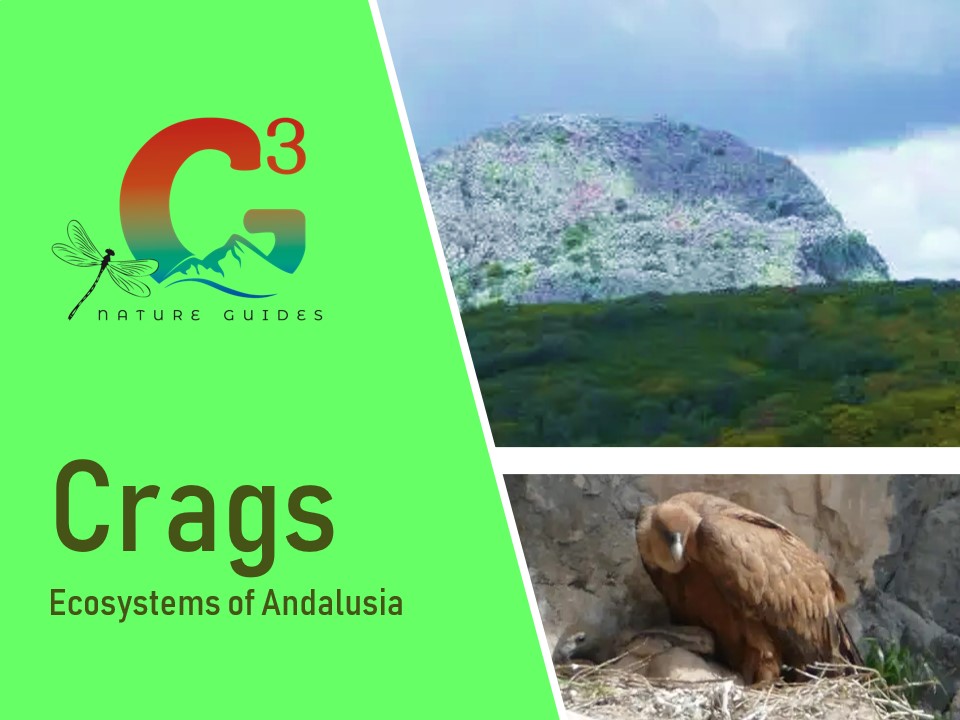
The power of petrified nature: limited access and remarkable wildlife.

Andalusia is a mountainous region, with an abundance of limestone mountain ranges characterized by steep and rugged reliefs and abundant rocky outcrops, immense walls, canyons and crags.

Regarding the rock vegetation, it is scarce due to the verticality of the environment and the non-existent or minimal soils. But there are some species and, in fact, the

The cliffs are inaccessible places and ideal nesting sites for large birds of prey: Griffon vulture(Gyps fulvus), GoldenEagle (Aquila chrysaetos), Bonelli’ sEagle (Aquila fasciata), Bearded Vulture (Gypaetus barbatus). They also host a specialized avifauna of passerines such as the rock thrush (Monticola spp), the Black Wheatear(Oenanthe leucura), the redstart (Phoenicurus ochruros) and the Crag Martin(Ptyonoprogne rupestris). We should also remember many urban birds that have adapted to live in cities and that are native to rocky environments, such as the Lesser Kestrel(Falco naumanni) and the House Martin(Delichon urbicum).

The mountain goat(Capra pyrenaica) is the queen of the sierra, moving with great agility through these ecosystems like no other mammal.
Caves are numerous in karst environments and host large populations of bats and invertebrates restricted to subterranean environments (hypogean).
The reptiles are also very abundant in stony areas where they have hiding places among the stones.

Typical nest of Griffon vulture(Gyps fulvus)

Located on a narrow ledge halfway up a high limestone cliff, probably at the level of an ancient gallery or cave of the karst model; formed by a large and rough accumulation of twigs on the ground and only protected by the overhang; the rocky walls stained with white guano, the nest environment covered with nitrophilous plants. The adult watches over the chick to ensure thermo-regulation, both the heat of midday and the cold of the night.
One of my best memories is watching a huge flock of more than a thousand Red-billed Choughs in the Sierra de Baza.
Blue Rock-thrush… in town

This species likes crags and any rocky substrate with verticality… No wonder it is so common in the Serranía de Ronda. Very curious by nature with its big eyes, observant posture and intense activity, this magnificent bird hunts all day long for numerous invertebrates, often rare species… The Blue Rock-thrush (Monticola solitarius) is my favorite bird and – icing on the cake – it breeds in front of my balcony on the roof of the village!
Leave a Reply