


Territories of temporary transition and surprises, extremely rich in the Iberian Peninsula.

Shrublands form a type of vegetation dominated by shrubs and bushes, and develop prior to the establishment of tree speciesand the establishment of forests. This dynamic, known as ecological succession, usually occurs in plots where trees have been previously eliminated by extractive logging, clearing or overgrazing, not to mention fires.
In other cases, ecological succession may be blocked at the shrub stage if local conditions prevent tree growth. This situation is observed for climatic reasons in high mountains (oro- and criomediterranean bioclimatic levels) or edaphological reasons in extremely dry soils or with high salinity.

A list of shrub/scrub-dominated vegetation in Andalusia:
- Piornales and juniper-sabinares (cushiony and creeping vegetation of high mountains).
- Jarales, heaths and canthuesales (siliceous scrublands)
- Romerales and tomillares (basophilic scrub)
- Tall broom thickets
- Tamujares (Securigena tinctoria) in temporary streams in the Sierra Morena.
- Coastal and inland salt marshes (halophilic vegetation)
The “Mediterranean scrubland“This is a popular expression used to identify the terrestrial ecosystem so typical of the Iberian Peninsula where forest and scrubland are intermingled. In Spain, foresters are known as “ingenieros de montes”.

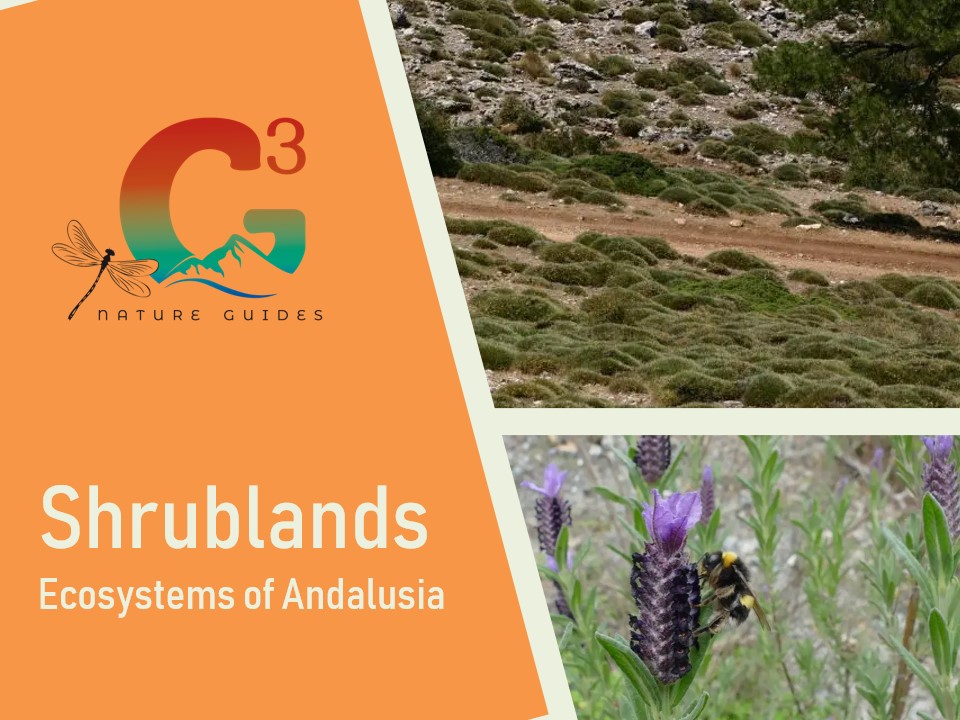
It is worth mentioning the curious high mountain cushion vegetation, a type of vegetation typical of the Iberian southeast and also present in Sierra de Las Nieves, but not found in other European mountains.
I have devoted several weeks of summer to the orthopterans of Cazorla and Segura, whose rarest and most interesting species seem to appreciate the shelter of the spiny, darned blue spruce cushions – one of my favorite habitats!

The Mediterranean forest is rich in shrubs that occasionally form patches of vegetation within the forests: mastic (Pistacia lentiscus), myrtle (Myrtus communis), etc.

The Iberian Peninsula is an important point of diversity for shrub legumes. Many of these plants have

Vegetation adapted to saline conditions (halophilic plants) appears far from the coast when the soil is in contact with salty streams or the former seabed (Guadalquivir channel). In these conditions, an
Leave a Reply