


The natural and cultural identity mark of the middle mountains of the Iberian southwest quadrant.

The dehesa is a Mediterranean forest ecosystem. It is even the traditional Iberian ecosystem par excellence, typical of the southwestern part of the peninsula whose extension covers up to four million hectares (40,000 km², the area of Extremadura), mainly in Salamanca, Extremadura, Andalusia (Sierra Morena) and Alentejo in Portugal.
It is mainly an agro-silvo-pastoral system developed in forests of the Genus Quercus, especially holm oaks(Quercus ilex = Quercus rotundifolia = Quercus ballota) or cork oaks(Quercus suber). In summary, the dehesa is an open forest with the presence of livestock (Iberian pigs that consume acorns or Merino sheep) and in some cases planted with fodder crops or cereals, without forgetting the use of forest products, mainly firewood and cork. The land can be private or communal (Dehesa Boyal).

The dehesas resemble, in their physiognomy, the disappeared forests of the plains where the great herds of wild herbivorous mammals that our ancestors knew used to graze.
The holm oak is THE Iberian Quercus par excellence, adapted to a great number of climates and soil conditions, and especially abundant in the southwest of the Peninsula. For this reason, the holm oak pastures are the most representative and common. However, the concept can be extended to all forest species, and even to curios such as tamarisks or cornicabras.
In other parts of Europe, there are similar ecosystems, although smaller in extent, e.g. apple orchards in western France, Änge in Sweden, etc.

They are very varied depending on the characteristics of the managed forests, in particular the density of the trees and the main uses. The concept can also be considered in a broader sense, with other forest essences, for example tamarack pastures, with holm oak pastures being the most representative.
Depending on the degree of farming intensity, the plant diversity of herbaceous species is important.
In spring and summer, the tree canopy provides shade for animals and delays water stress to the herbaceous plants growing around it.

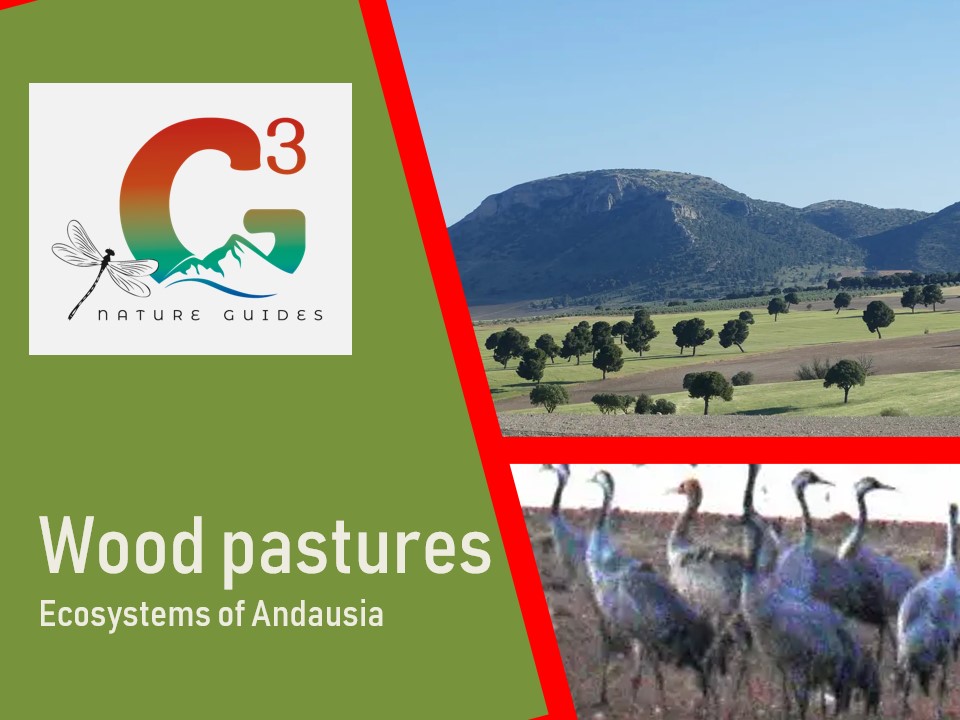
In winter, cranes(Crane), which breed mainly in Scandinavia, come to spend the season and consume acorns.
Common Crane counts on the banks of Sierra Boyera in midwinter … and the surprise of photographing Aino, a telemarked Crane, the first known individual to descend through Italy and ascend through Spain.
Leave a Reply