


Very diverse botanical Family mainly represented in the tropics. Its presence in Europe often goes unnoticed… and yet, its photogenic flowers provoke passions.


Small miracles of nature, these plants require specific environmental conditions (pH, humidity) and depend on the obligatory collaboration of fungi (for mycorrhizae), insects (for pollination) and herbivorous mammals (to keep the environments open).
Most species bloom during the short period of spring, coinciding with the most pleasant times to discover the biodiversity of a region.

The orchids of Andalusia
Little known divas
Plants scattered here and there, most of the time in the best habitats, and with a somewhat ‘capricious’ ecology.
‘Need for space’. Most species colonize recently opened environments, at least with patches of bare soil.
Their tiny seeds lack nutritional reserves and successful germination depends on a ‘chance’ cooperation with a fungus potentially present in the soil.
‘Light needing‘, high light habitats (open areas, meadows, grassy roadsides), often dry but not too arid.
Plants with bulbs, which serve as a reserve to get them through the bad season (summer in Spain) when the stem and leaves of the year have withered.
Its bulbs require stable conditions (unturned agricultural land) but do not tolerate competition with overly dense pastures, or environments overly enriched in nutrients from high-density livestock grazing.

Mediterranean flowering plants
In Europe, the greatest diversity of orchids is observed around the Mediterranean… Most species have a rather restricted range, they are found almost exclusively there.
Andalusia is home to about sixty species (see footnote). The most emblematic species of this territory are the Iberian-Maghrebi endemisms: Abejera dyris (Ophrys omegaifera dyris), Abejera atlantica(Ophrys atlantica), Orchis de Argelia(Platanthera algeriensis), Orchis de Cazorla(Orchis spitzelii cazorlensis), Serapias morisca(Serapias strictiflora), Orquídea púrpura (Epipactis atrorubens subsp. parviflora) and Two-leaved Gennaria(Gennaria diphylla).
As a general rule (not exclusively, far from it), orchids prefer limestone soils: Grazalema, coastal mountain ranges of Malaga, Cazorla and Segura, limestone slopes of Sierra Morena… places of interest for European orchidophilia that have all the favorable conditions for dense orchid populations.

Mimicry and ‘sexual deception
Few plants have brought the coevolution between flowering plants and pollinating insects to its climax (!).
A very rare mechanism in nature of ‘sexual deception‘ is mainly observed in the orchid family and in particular in the Ophrysa Genus almost exclusive to the Mediterranean basin, whose species are specialized in this strategy.
The orchid mimics an insect by its shape and especially by the emission of female sex pheromones… inducing males (solitary bees, small wasps) to mate with its flowers. The pollen grains adhere to the back of the male, which visits several Ophrys and thus ensures pollination.
Plants save traditional nectar production to attract insects… but become ultra-dependent on a very small number of pollinators.

Frequent natural hybrids
Hybridization, i.e. crossing between individuals of two different species, is a common phenomenon among orchids, particularly in the Genus Ophrys, Orchis, Epipactis and Dactylorhiza….
In botanical nomenclature, hybrids are identified by the x-mark and may bear a dedicated name (similar to a species name) or indicate the two parent species by separating them with the x-mark. For example, Orchis x semi-sacatta(O. champagneuxii x O. collina). Photo: Enrique Calzado Rivillas.
The task of botanists is particularly complicated/interested by the existence of these hybrids that increase morphological variability in species that are already not very stable. It is not uncommon to interpret ‘different’ individuals or small clonal populations, either as a new species or as more or less stable hybrids.

Orchids: list of the species of Andalusia
| # | SPECIES¹ | COMMON NAME2 | ID. | DISTRIBUTION | HABITAT3 |
|---|---|---|---|---|---|
| 1 | Ophrys speculum | Mirror of Venus orchid | EvidentA | Euro-med, Turq, Mgb | Pasture |
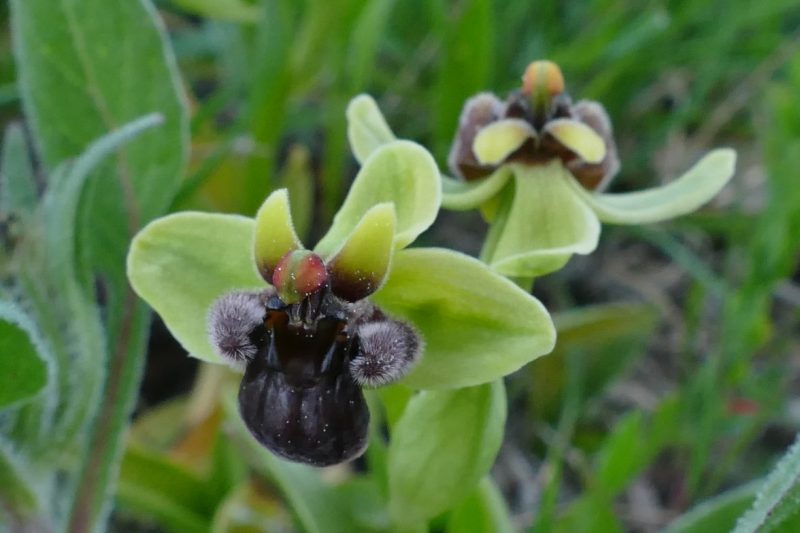
| 2 | Ophrys bombyliflora | Bumble bee orchid | Unmistakable | Euro-med, Turq, Mgb | Pasture |
| 3 | Ophrys tenthredinifera | Sawfly orchid | Unmistakable | Euro-med, Turq, Mgb | Pasture |
| 4 | Ophrys lutea | Yellow bee orchid | UnmistakableA | Euro-med, Turq, Mgb | Pasture |
| 5 | Ophrys agg. fusca | Dingy bee orchid | Tricky | Euro-med, Turq, Mgb | Pasture |
| 6 | Ophrys omegaifera dyris | Dyris bee orchid | Tricky | Spain, Mgb. Other subsp. Med. islands, Turq. | Pasture |
| 7 | Ophrys atlantica | Andalusian bee orchid | Unmistakable | Andalusia (Malaga), Mgb | Pasture |
| 8 | Ophrys apifera | Bee orchid | Easy | Europe, Turq, Mgb | Pasture |
| 9 | Ophrys sphegodes | Early spider orchid | Unmistakable | Europe, Turkey, Caucasus | Pasture |
| 10 | Ophrys scolopax | Woodcock bee | Easy | Europe, Turq, Mgb, Caucasus | Pasture |
| 11 | Limodorum abortivum | Violet limodore | Easy | Europe, Turq, Mgb, Caucasus | Undergrowth |
| 12 | Limodorum trabutianum | Trabut’s limodore | Easy | W Euro-med, Mgb | Undergrowth |
| 13 | Spiranthes aestivalis | Summer lady’s tresses | Easy/Delicate | W Europe, Mgb | Moist soil |
| 14 | Spiranthes spiralis | Autumn lady’s tresses | Easy/Delicate | Europe, Turkey, Caucasus | Moist soil |
| 15 | Neottia nidus-avis | Bird’s nest orchid | Unmistakable | Europe, Turkey, Caucasus | Undergrowth |
| 16 | Platanthera algeriensis | Green butterfly orchid | Unmistakable | W Euro-med, Mgb | |
| 17 | Himantoglossum robertianum | Giant orchid | Unmistakable | Europe, Turq, Mgb | Pasture |
| 17 | Himantoglossum hircinum | Lizard orchid | Unmistakable | W Europe, Mgb | Pasture |
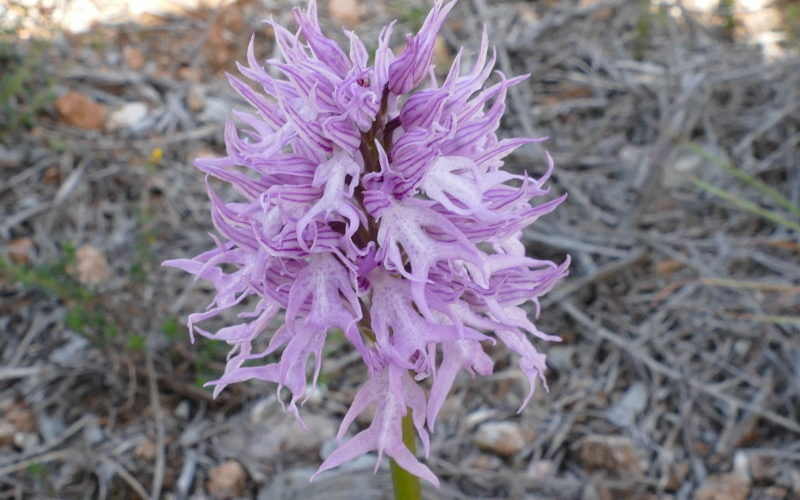
| 18 | Orchis italica | Naked man orchid | Easy | Euro-med, Turq, Mgb | Pasture |
| 19 | Orchis simia | Monkey orchid | Easy | Europe, Turkey, Caucasus, Mgb | Pasture |
| 20 | Orchis purpurea | Orchis purpurea | Easy | Europe, Turkey, Caucasus, Mgb | Pasture |
| 21 | Orchis olbiensis | Olbia orchid | Tricky | W Euro-med, Mgb | Pasture |
| 22 | Orchis mascula subsp. mascula | Early purple orchid | Tricky | Europe, Turkey, Caucasus, Mgb | |
| 23 | Orchis langei = D. mascula subsp. laxifloromis | Lange’s orchid | Tricky | Iberia, France, Mgb | |
| 24 | Orchis spitzelii cazorlensis | Cazorla orchid | Unmistakable | Spain, Mgb. Other subsp. Euro-med, Turq | |
| 25 | Anacamptis papilionacea | Pink butterfly orchid | Unmistakable | Euro-med, Turq, Mgb | Pasture |
| 26 | Anacamptis laxiflora | Laxed-flowered orchid | Tricky | W Euro-med, Turq | Moist soil |
| 27 | Anacamptis palustris | Swamp orchid | Tricky | Europe, Turkey, Caucasus | Moist soil |
| 28 | Anacamptis morio subsp. morio * | Orchis bouffon *. | Tricky | Europa | |
| 29 | Anacamptis morio subsp. champagneuxii | Champagneux orchid | Tricky | Iberia, France, Mgb | |
| 30 | Anacamptis coriophora | Bug orchid | EvidentA | Europe, Turkey, Caucasus, Mgb | Pasture |
| 31 | Anacamptis collina | Saccate-lipped orchid | Unmistakable | Euro-med, Turq, Mgb | Pasture |
| 32 | Anacamptis pyramidalis | Pyramidal orchid | Unmistakable | Europe, Turkey, Caucasus, Mgb | Pasture |
| 33 | Neotinea ustulata | Burnt-tipped orchid | Unmistakable | Europe, Caucasus | Pasture |
| 34 | Neotinea tridentata conica | Toothed orchid | Easy | Spain, Mgb. Other subsp. Europe, Turkey, Caucasus | Pasture |
| 35 | Neotinea maculata | Dense-flowered orchid | Unmistakable | Euro-med, Turq, Mgb | |
| 36 | Gymnadenia conopsea | Fragant orchid | Unmistakable | Europe, Turkey, Caucasus | Pasture |
| 37 | Dactylorhiza incarnata | Early marsh-orchid | Tricky | Europe, Turkey, Caucasus | Moist soil |
| 38 | Dactylorhiza majalis subsp. sesquipedalis = D. elata | Broad-leaved Marsh | Tricky | Iberia, France, Mgb. Other subsp. : Europe. | Moist soil |
| 39 | Dactylorhiza insularis | Corsican Orchid | Tricky | W Euro-med, Mgb | |
| 40 | Dactylorhiza romana subsp. guimaraesii = D. sulphurea | Sulfurous orchid | Tricky | Spain, Mgb | |
| 41 | Serapias cordigera | Heart-lipped tongue orchid | Tricky | W Euro-med, Mgb | Pasture |
| 42 | Serapias parviflora | Small flowers tongue orchid | Tricky | W Euro-med, Mgb | Pasture |
| 43 | Serapias vomeracea | Serapias vomeracea | Tricky | W Euro-med, Mgb | Pasture |
| 44 | Serapias strictiflora | Moorish tongue orchid | Tricky | Spain, Mgb | Pasture |
| 45 | Serapias lingua | Common tongue orchid | Easy | W Euro-med, Mgb | Pasture |
| 46 | Neottia ovata | Twayblade | Easy | Europe, Turkey, Caucasus | |
| 47 | Orchis anthropophora | Man orchid | Easy | W Europe, Turq, Mgb | Pasture |
| 48 | Gennaria diphylla | Gennaria | Unmistakable | W Euro-med, Macaronesia, Mgb | Undergrowth |
| 49 | Cephalanthera rubra | Red helleborine | Easy | Europe, Turq, Mgb | Undergrowth |
| 50 | Cephalanthera longifolia | Sword-leaved helleborine | Easy | Europe, Turq, Mgb, Caucasus | Undergrowth |
| 51 | Cephalanthera damasonium | White helleborine | Easy | Europe, Turkey, Caucasus | Undergrowth |
| 52 | Epipactis palustris | Marsh helleborine | Easy | Europe, Turkey, Caucasus | Moist soil |
| 53 | Epipactis atrorubens subsp. parviflora ** | Iberian Dark-red **. | Dificult | Spain | Undergrowth |
| 54 | Epipactis microphylla | Small-leaved helleborine | Dificult | Europe, Turkey, Caucasus | Undergrowth |
| 55 | Epipactis helleborine | Broad-leaved helleborine | Dificult | Europe, Turq, Mgb, Caucasus | Undergrowth |
| 56 | Epipactis helleborine subsp. tremolsii | Tremols’ helleborine | Dificult | Euro-med, Turq, Caucasus | Undergrowth |
(1) SPECIES. ** Iberian endemism of wide distribution . *** Localized Iberian endemism.
(2) COMMON NAMES: We have chosen to simplify the accepted common names.
Orchids of Andalusia… a list never closed.
The systematics and nomenclature of European orchids are so complex that it is practically impossible to find two works in which the same species names coincide… We follow here the recent reference guide to European and Mediterranean orchids: Kuhn, Pedersen, Cribb (2019). Field guide to the orchids of Europe and the Mediterranean. Royal Botanic Gardens, Kew. A choice that favors the recognition of a number of species and subspecies lower than that of most specialized authors… and that, relentlessly, will not satisfy the amateurs of ‘fixing’ the variations observed in nature.
Let us point out the main problems to be solved for orchid taxonomy: the existence of a great floral morphological variability in certain “species”; clonal populations that bias our perception of the morphology of a group of individuals that seem to be differentiated from the others; the insoluble problem of how to interpret the existence of sympatric subspecies; the absence of genetic sequencing for many taxa (in particular, local variations promoted to species rank); the possibility that each association of Ophrys with different pollinating insects induces microspeciation.
For Andalusia, the taxa most subject to debate are the aggregates of Ophrys fusca, Orchis morio and the Genus Epipactis.
Field guide to orchids
Group of Ophrys… bee orchids
Extravagant plants with unique shapes… whose label (large lower petal) mimics an insect in shape and texture. The ‘sexual deception’ is so effective that the flower has ‘abandoned’ the nectar reward (absence of nectar tube).
Ophrys speculum

O. bombyliflora

O. tenthredinifera

O. lutea

O. agg. fusca

O. omegaifera dyris

O. atlantica

O. apifera

O. sphegodes

O. scolopax

Genus with few species
A small group of species quite different and easy to identify in the field. Note the Néottie Nid d’oiseau, a non-chlorophyllous (leafless) parasitic species totally dependent on its mycorrhizae.
Limodorum abortivum

L. trabutianum

Spiranthes aestivalis

S. spiralis

Neottia nidus-avis

Platanthera algeriensis

Himantoglossum robertianum

H. hircinum

Orchis Group (Anacamptis, Gymnadenia and Neotinea)
A large group of often similar species whose genetics have recently altered understanding. The current situation is not very intuitive since in the current classification, species belonging to neighboring Genus are sometimes more similar to each other than within their own Genus (!).
Orchis italica

Orchis simia

Orchis purpurea

Neotinea tr. conica

Orchis olbiensis

Orchis mascula
subsp. male

Orchis langei
D. mascula laxifloromis

Anacamptis papilionacea

A. laxiflora

A. palustris

A. morio
subsp. died

A. morio
subsp. champagneuxii

A. coriophora

Neotinea maculata

Orchis cazorlensis

Anacamptis collina

Anacamptis pyramidalis

Neotinea ustulata

Gymnadenia conopsea

Dactylorhiza Group
Group similar to orchis s.l.. The two Genus are most easily distinguished by the morphology of the tuber, with digitate forms in Dactylorhiza (as indicated by the scientific name). Genus of markedly northern distribution, loving the coolness of wet meadows and riverbanks, and subordinated to the mountainous areas of the southern Iberian Peninsula.
Dactylorhiza incarnata

D. majalis = D. elata

D. insularis

D. romana = D. sulphurea

Serapias Group
Very unique Genus of orchids whose morphology and label color recall a particularly visible and attractive tongue (!), at least to beetles and other visitors. The rest of the corolla forms a small tunnel that serves as a night shelter for insects, whose regular visits thus ensure pollination – an unusual strategy! Less well known than in Ophrys, certain species (Serapias lingua) have also developed fragrances typical of ‘sexual deception’.
Serapias cordigera

S. parviflora

S. vomeracea

S. strictiflora

S. lingua

Green flowering species
A small group of remarkable species that have abandoned the bright floral colorations to maximize the chlorophyll parts. This adaptation has appeared several times throughout evolution and in different Genus, a situation that only genetics has recently made it possible to identify.
Neottia ovata

Orchis anthropophora

Gennaria diphylla

Cephalantera and Epipactis Group
Most forest species unlike most orchids in Europe. Epipactis form a very complex group. Species previously cited in Andalusia, E. kleinii, E. cardina, E. lusitanica or E. fageticola were not retained by Kühn et al. (2019). However, these species are recognized in Flora Iberica and specialists will be interested in studying them.
Cephalanthera rubra

C. longifolia

C. damasonium

Epipactis palustris

E. atrorubens
subsp. parviflora

E. microphylla

E. helleborine

E. tremolsii

Leave a Reply