


What could be more fascinating than watching birds and mammals in the middle of nature. Very often, these encounters are fleeting; a moment later the animal has already fled. But how good it is to experience this brief moment that connects us with the wild, the surprise of life, establishes a bond with nature, with a being we never met. Imagine being able to enjoy more time together and observe their natural behavior. It is possible! Spying on their reproductive behavior, the period in which animals are most exposed to our gaze.
Let’s discover the most fascinating spectacles of the great wildlife of the southern Iberian Peninsula. Find a list of wildlife documentaries in Andalusia.
Deer rutting in Andalusian forests
Alberto Herrero (Youtube)
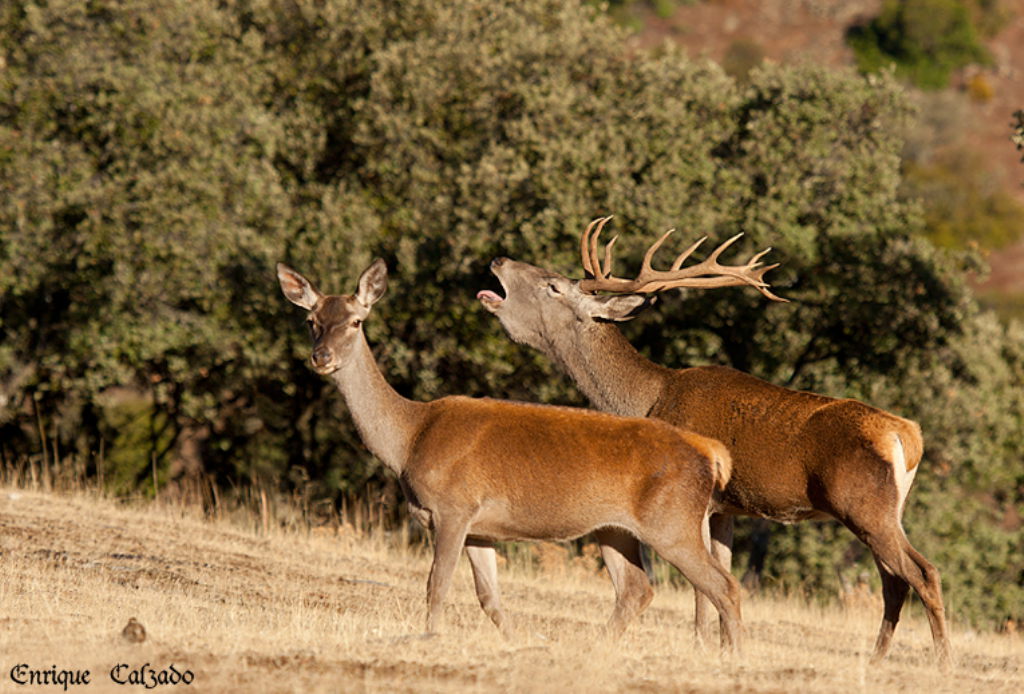
Autumn rains signal the new hydrological year and a certain revival of ecosystems. The dominant deer (Cervus elaphus) emit guttural, hoarse and powerful calls that are very easy to hear from a distance. When confronted, two individuals face each other by violently clashing their antlers. These appendages are actually bones (not horns) that fall off and grow back each year, becoming larger. An incredible expenditure of energy is invested to access reproduction.
Typical year: October.
The birth of the salamanders
Evascoping (Youtube)
The rainy and mild nights (>14ºC) of autumn are ideal for observing the activity of salamanders (Salamandra salamandra) in the forests of Andalusia, a very discreet species in other circumstances. It is much easier to discover the larvae in the spawning areas. Females give birth directly to larvae (eggs hatch in the uterus and the young larva is already developing in the body of the adult), even exceptionally juveniles (i.e. metamorphosed individuals in the mother’s body that will not experience the larval stage in the ponds).
Typical year: October – February.
Mountain goat snoring in the Betic Cordillera
Jose Manuel Hiniesto (Youtube)
The rut(ronca) of the ibex (Capra pyrenaica) is spectacular, with particularly violent clashes between males. Remember that these ritual fights select the most powerful individuals (which weigh almost twice as much as the females), more apt to pass on their offspring. Females in heat run errands to attract the attention of males. Otherwise, the rest of the year, the species is gregarious and shy.
Typical year: late November – early December.
Aviaries in the Guadalquivir river islands
Carlos de Hita (Youtube)
Little Egrets (Egretta garzetta), Cattle Egrets (Bubulcus ibis) and Black-crowned Night-Herons (Nycticorax nycticorax) like to take refuge in riparian woodland and gather in communal dormitories in winter and breeding colonies in spring, mainly on river islands, protected lagoons or even near landfill sites (in winter). These mixed colonies are regularly enriched by Great Egrets (Ardea alba), Grey Herons (Ardea cinerea), Squaco Herons (Ardeola ralloides) and large marsh birds, White Spoonbills (Platalea leucorodia) and Glossy Ibises (Plegadis falcinellus). These ‘pajareras’ are full of movement, breeding activity and social interaction.
Typical year: December – April.
Iberian lynx in Sierra Morena
Cesar Gil (Youtube)
Winter is undoubtedly the best season to observe the Iberian lynx (Lynx pardinus) in the wild, the most classic place being the Sierra de Andújar. During this period, individuals become more gregarious and interactions between individuals increase. You can even hear the growls of these big wild cats.
Typical year: end of December – January.
Crane roosts and migration
Aquae Foundation (Youtube)
At present, the commonCrane (Grus grus) no longer breeds in Spain. However, they continue to visit our region during the winter in families (pairs accompanied or not by their offspring). Large flocks congregate at dusk and form large communal roosts in inaccessible wetlands. Also noteworthy are theGreylag Goose (Anser anser) that also winter in Andalusia (Doñana) in large groups.
Typical year: all winter, departures in February.
Courtships of the large resident raptors in the Iberian Mountains
Alberto Alvarez Lopez (Youtube)
Spanish Imperial Eagle (Aquila adalbertii), Bonelli’s Eagle (A. chrysaetos), Bonelli’sEagle (A. fasciata) and Cinereous Vulture (Aegypius monachus), large raptors that spend the winter in the Iberian Peninsula and begin their nuptial courtships very early in the season before the explosion of spring life. Austere nuptial processions in full flight in the silence of winter nature.
Typical year: January – March.
Reproduction of amphibians in temporary Mediterranean ponds
Manuel Gracia (Youtube)
Mediterranean temporary ponds host amphibian reproduction because all larvae of European species are aquatic. They are noticeable from afar on cold winter nights because the males are not very discreet and vocalize loudly to attract females. Natterjack toads (Bufo calamita) and southern frogs (Hyla meridionalis) are undoubtedly the loudest singers and rub shoulders with active nocturnal raptors.
Typical year: February – April.
White Storks in the bell towers of white villages
eitbfeedback (Youtube)
The creaking of the White Storks (Ciconia ciconia) resounds like a metronome and announces the arrival of spring. The species appreciates the proximity to humans and builds large nests in inaccessible places, once the bell towers of villages, today tall modern buildings, high voltage pylons along highways, etc.. Let us point out some natural colonies in dehesas ( Dehesa Abajo, Los Pedroches).
Typical year: March.
Sociability in Spanish burrows
Efe (Youtube)
Mone rabbits (Oryctolagus cuniculus) are social and gregarious animals that live close to their burrows, visible all year round and very active in spring when herbaceous vegetation is abundant. This keystone species of the Spanish Mediterranean landscapes is the favorite prey of most predators (carnivorous mammals and birds of prey).
Great Bustard leks in cereal steppes
Wildlife & photo (Youtube)
Male Great Bustards (Otis tarda) are very imposing, weighing more than twice as much as females, and gather in small groups (lek) at high, visible points on the cere plains. The dominant male occupies the best position while performing his nuptial courtship in a “foam bath” visible from several kilometers away. More curious: the male hides his head and “parades backwards” showing the swollen white plumage on the back of the body.
Typical year: March.
Migration of freshwater fish
Luis Guerrero (Youtube)
River fish move around a lot and very often make migrations, some species going to the sea to spend several years there, while others are limited to local movements. Two species that move in groups are easier to observe in the large rivers of the southern Iberian Peninsula: the Andalusian barbel (Luciobarbus sclateri) and the Southernstraight-mouth nase (Pseudochondrostoma willkommii).
Typical year: April?
Little Bustards jumping in the Iberian pseudosteppes
The courtship display of the Little Bustard (Tetrax tetrax) is remarkable: small hops followed by a counterproductive vocalization. An increasingly rare species throughout Spain.
The large colony of Greater Flamingos at Laguna Fuente de Piedra
Juan C. Díaz (Youtube)
Depending on the year, the colony of Greater Flamingo (Phoenicopterus phoenicopterus) in Fuente de Piedra can reach 20,000 adults and 8,000 pairs. An unforgettable sight. In recent years, the lesserGreater Flamingo (Phoenicopterus minor) has also frequented the lagoon in small numbers.
Resident species.
The European colony of Northern bald ibis hermits
Bizarro Incrível (Youtube)
Thanks to a reintroduction program, the Northern bald ibis (Geronticus eremita), one of the most endangered bird species in the world, has settled definitively in Andalusia and has established a small colony near Barbate (Cadiz). It is an ornithological attraction of worldwide interest. The species is resident and visible all year round in Andalusia.
Resident species.
Leave a Reply