


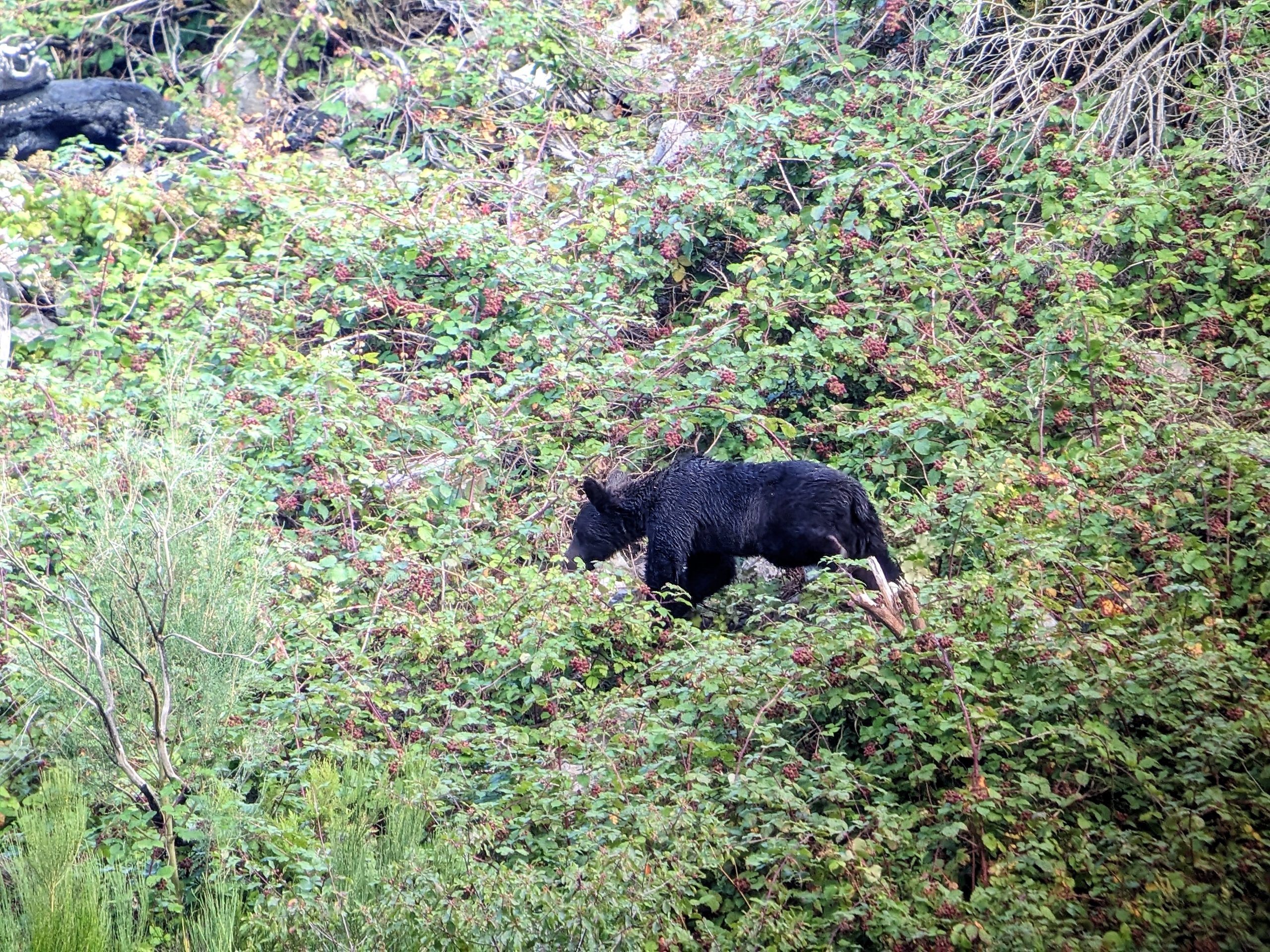
Watching the Cantabrian Brown Bear in its natural environment is a truly extraordinary experience. What an emotion invades us when the plant-eater appears on our retina, carrying out its activities without being threatened. The western Cantabrian Sea, between Asturias and León, has become the Mecca of nature and bear watchers in Europe. A trip that does not disappoint and should be made during the summer season, when Mediterranean Spain is hell.

The first instinct when you think about being close enough to see a bear in the wild… is fear. Healthy and normal thinking a priori. But let’s repeat that in this particular region of Europe bears pose (practically) no danger. What is also crazy is to think that the famous North American grizzly bear is a subspecies of brown bear (Ursus arctos), i.e. a very close relative of the Cantabrian brown bear. But let’s keep calm, Cantabrian bears are harmless.
Brown bear in Degaña and Faraponas in Asturias
First of all, their size is smaller… but still very imposing compared to a human being. This may be due to several factors, including the fact that the climate in Spain is less cold than in other European regions populated by ursids. Therefore, bears need less protein to maintain their metabolism, and even if they do forage for carrion from time to time, they cannot be considered predators. Essentially frugivorous, they feed on fruits of the forest (and orchards!). More importantly, the very long coexistence of the species with the shepherds settled in the mountains, and the systematic hunting of bears by man… ended up making the bear very shy (today) that flees almost systematically if it distinguishes a human silhouette.
At the end of August, bears visit hazelnut trees
You have to eat a lot of hazelnuts or blueberries to cover the energy needs of such a heavy animal! Adults weigh well over 100, even 200 kilos. The bears thus spend long periods feeding only on small fruits, an ideal circumstance for us observers, who love to watch them busy for so long.
Once again, the bear near Pola de Somiedo
Observing bears is not seeing a bear… There are multiple configurations in the field: solitary individuals, males or females (we can never be sure, although statistics tend to indicate that light-colored individuals tend to be more females and black ones more often males), mothers accompanied by one or two cubs, who become independent after the second winter, solitary youngsters or even with their siblings.
And the behavior of mammals is varied. Depending on the season, plantigrades feed on different fruits, blackberries, cherries, hazelnuts, beechnuts, chestnuts, etc.
Leave a Reply