


“Thalassa”: a link between the peoples of the sea – a mysterious and fertile marine ecosystem.

The sea covers more than 70% of the Earth’s surface, contains more than 96% of the water reserves and is the environment where life originated. Today, most animal groups are still exclusively marine. That is how important the seas and oceans are in our lives. However, it is an environment we know little about, seemingly far from cities and the needs of our civilization.
In Andalusia, the marine ecosystem is represented by the Atlantic Ocean and the Mediterranean Sea. The westernmost part of the Mediterranean and close to the Strait of Gibraltar is the so-called Alboran Sea.

The main difference between seawater and most inland waters is obviously the chemical composition and the presence of mineral salts, mainly chloride and sodium ions.
Fresh water (salinity <0,5 g/l)
- Rainwater, 0.2 g/l
Brackish water (0.5-30 g/l)
- Baltic Sea, 6 g/l
Seawater (30-50 g/l)
- North Atlantic, 30 g/l
- Sea water average, 35 g/l
- Mediterranean Sea, 38 g/l
- Red sea, 40 g/l
Hypersaline water / brine (> 50 g/l)
- Laguna de Fuente de Piedra, 96 g/l (maximum)
- Saturation level, 270 g/l (salt crystallization)
- Dead Sea, 330 g/l

The avifauna is the most easily observed biodiversity of the high seas (pelagic) at sea from a boat or on land from a cape. Seabirds are especially abundant in winter and during migrations being common Scopoli’s Shearwater(Calonectris diomedea), Balearic Shearwaters(Puffinus mauretanicus) and Northern Gannets(Morus bassanus) among others.

Marine mammals of the high seas are represented by baleen whales such as the Fin whale(Balaenoptera physalus) and by cetaceans with teeth, such as the oceanic dolphins common dolphin(Delphinus delphis), striped dolphin(Stenella coeruleoalba), bottlenose dolphin (Tursiops truncatus), short-finned pilot whale (Globicephala melas) and orcas (orcas), Common bottlenose dolphins(Stenella coeruleoalba), bottlenose dolphins(Tursiops truncatus), pilot whales (Globicephala melas) and killer whales (Killerwhales) on the one hand, and sperm whales(Physeter catodon) on the other hand.
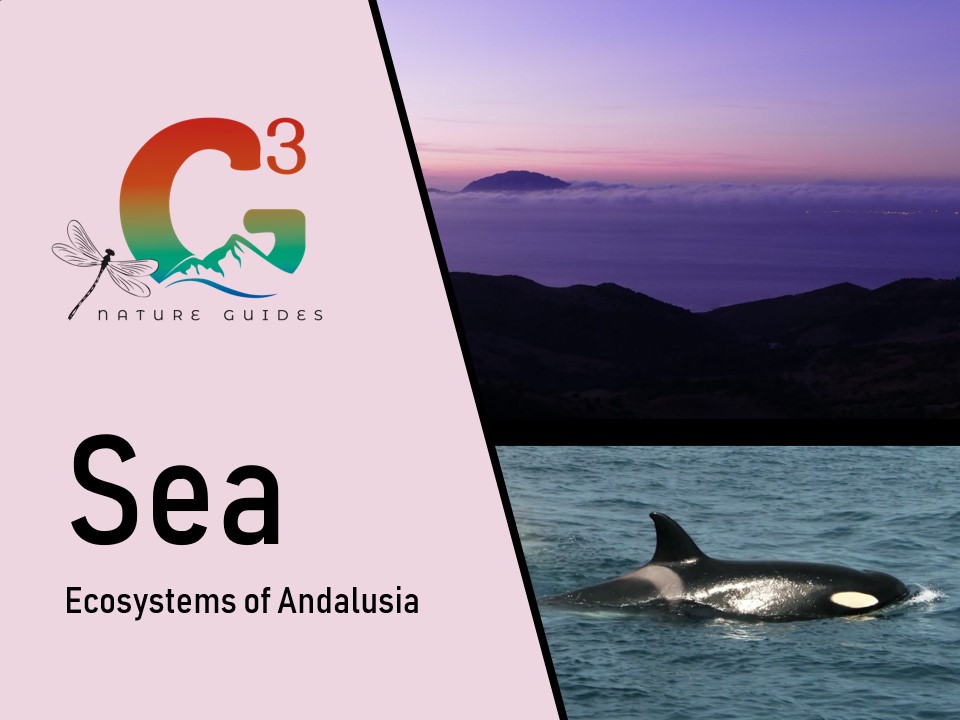
And suddenly, a blood stain appears in the sea … and a whole Family of Killer whales: females that have just finished hunting a tuna, a juvenile that comes to caress the hull of the boat, and from a distance, the large fin of a cautious male.

Among the fish are large predators: bluefin tuna(Thunnus thynnus) and swordfish(Xiphias gladius). Small pelagic fish such as sardines
We can close this short list of marine fauna withjellyfish, which are becoming more and more frequent, and among them two very peculiar species because they are floating and drifting. These are the dangerous Portuguese caravel(Physalia physalis) and the harmless purple sea sail(Velella velella).
Leave a Reply