


One animal group, in particular, offers the greatest pleasure to nature watchers: the spectacle of birds inhabiting wetlands, especially abundant around the Mediterranean.
On this page you will find: 1) Where are the best wetlands, 2) What groups of birds you will see, 3) How to recognize them, 4) When to come and 5) Ethical tips and on your own vs. with a guide.
A multitude of species cohabit and feed frantically in lagoons and marshes, creating an extraordinary hustle and bustle. At other times, these same birds find refuge and rest in the greatest tranquility, waiting to resume their migrations. Quite a spectacle…
Specialized ornithological tours
Wetlands of international interest in Andalusia
The Andalusian Wetlands Inventory(IHA) has 244 protected natural areas, located mainly on the southwestern coast of the region. The 7 most important wetlands are home to 90% of the waterfowl populations.
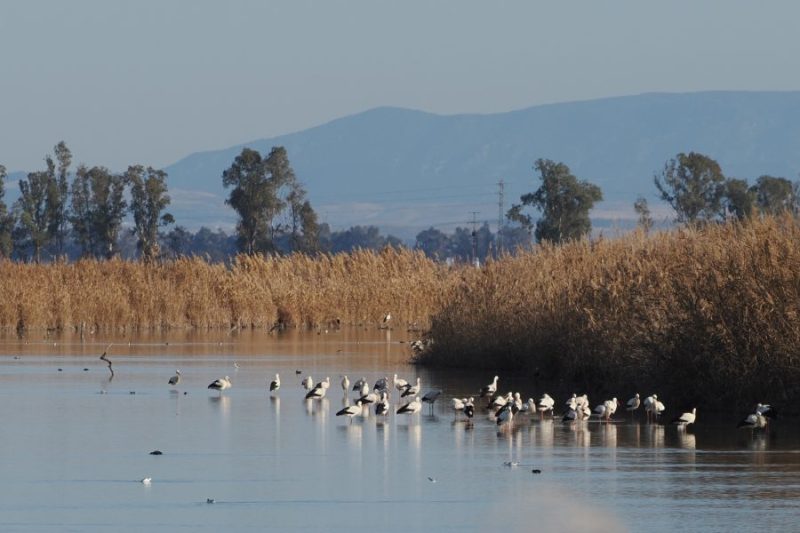
As we have already mentioned, Doñana is the most prestigious wetland in Spain: the marshes of the Lower Guadalquivir (Doñana National Park) and its peripheral lagoons (Dehesa Abajo, Brazo del Este, etc.) provide shelter to hundreds of thousands of waterfowl throughout the year.

Other outstanding areas are: the Odiel Marshes (Huelva); the Bay of Cadiz and La Janda (Cadiz); Fuente de Piedra and the Guadalhorce river mouth (Malaga); and the Cerrillo salt flats (Almeria).
The most emblematic wetland in Spain and a World Heritage Site. Its extensive marshes, lagoons and coastal dunes are home to exceptional biodiversity, being the main winter quarters in Europe for hundreds of thousands of waterfowl, such as geese and ducks, and a refuge for iconic species such as the Iberian lynx and the imperial eagle.
Biosphere Reserve located at the confluence of the Tinto and Odiel rivers. This complex of tidal marshes and salt marshes is famous for hosting one of the largest breeding colonies of Spoonbill in Europe, as well as being a crucial enclave for waders and seabirds on the Atlantic migratory route.
A unique coastal wetland where marshes, traditional salt marshes and estuaries coexist. Its proximity to the Natural Park and the Strait of Gibraltar makes it an essential resting and feeding area for a wide variety of waterfowl and waders, especially during migration.
Formerly a dried-up lagoon, now a vast agricultural plain and wet grassland. It is a legendary place for the observation of steppe birds and raptors, especially during migration, when thousands of kites, storks and cranes concentrate in their fields.
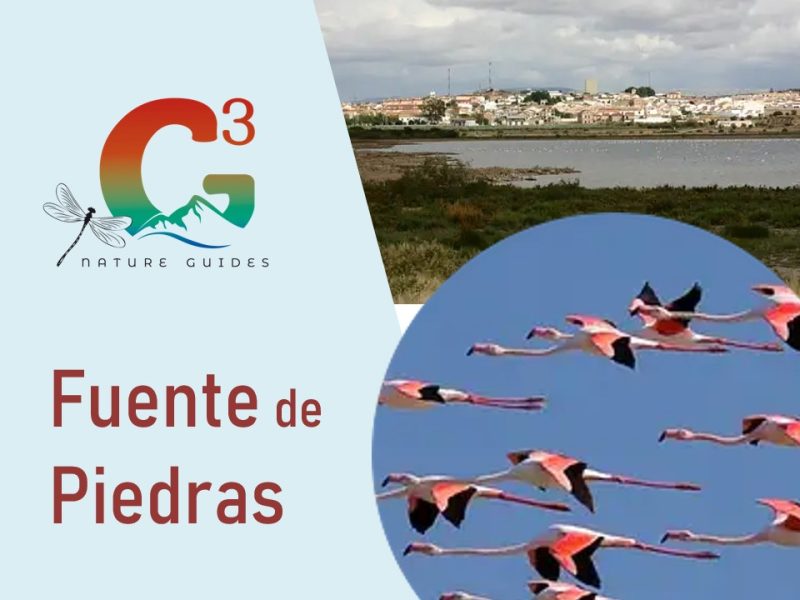
The largest inland lagoon in Andalusia and the most important Greater Flamingo breeding colony in the Iberian Peninsula. Its shallow saline waters attract thousands of these birds, whose breeding success depends directly on the water levels of the lagoon.
An oasis of biodiversity in the heart of the metropolitan area of Malaga. This natural area formed by river branches, lagoons and beaches is a vital enclave for migratory birds, which find here a resting place and food on their journey between Europe and Africa.
Representative of the Almeria wetlands, these abandoned salt pans and seasonal ponds are a vital refuge in a semi-arid area. They are especially important for steppe birds and as a water point for wildlife in a very arid environment.

Waterfowl and wetland birds of southern Spain
About fifty species are resident and visible throughout the year in Doñana, and their numbers are often strongly reinforced during the winter period. Among them, the large waders (Spoonbills, Greater Flamingoes and Glossy Ibis), present in southern Spain in large flocks, stand out.
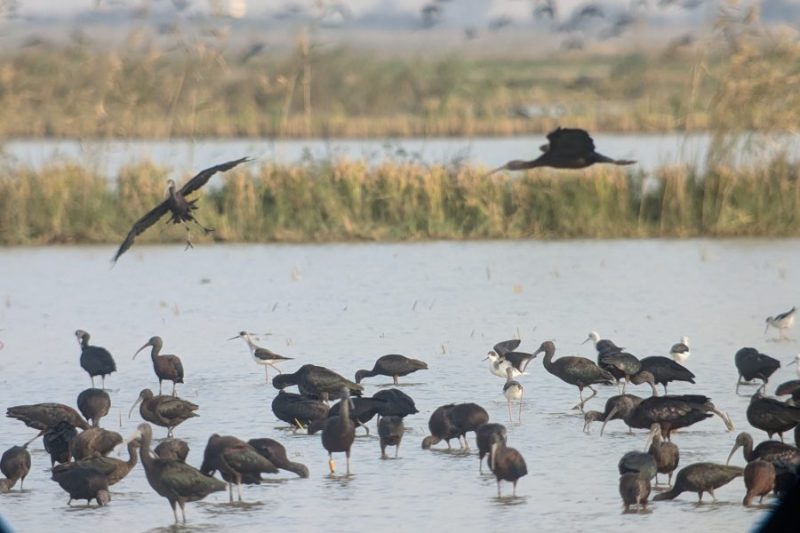
These species are accompanied by about forty species only present at this time (wintering birds). Doñana thus becomes one of the most important “winter quarters” in Europe with more than 600,000 waterfowl and wetland birds.
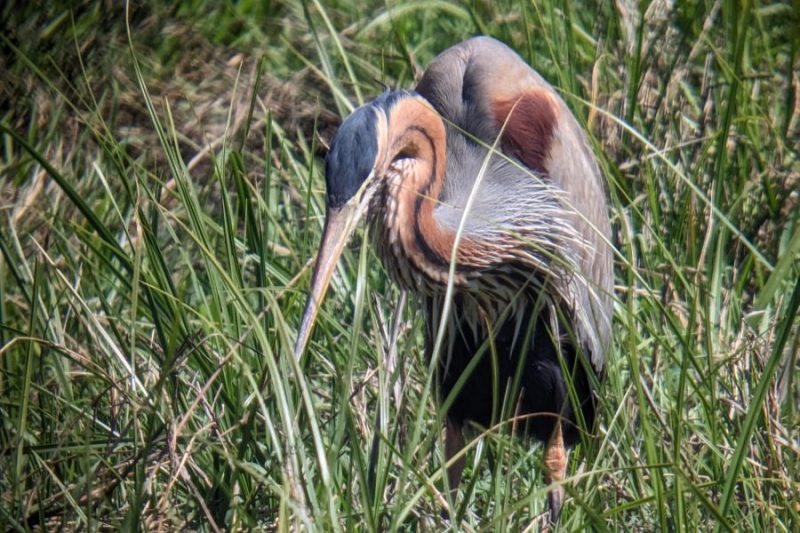
These are joined by strictly summer species that come to breed, such as Purple Heron, Crab Heron, Little Bittern and Little Bittern. Others, such as the Collared Pratincole, are closely linked to the open and dry environments of the wetlands.
In addition, four species are only visible during passage, i.e. the migratory phase: Spotted Crake, Garganey, Marsh Sandpiper and Curlew Sandpiper. The Water Rail is mainly a migrant.
Of course, every year, ornithologists observe specimens of vagrant species, which are very rare in this territory. Keeping a list of these birds requires consulting specialized sources and, by definition, their observation is always an exceptional event.
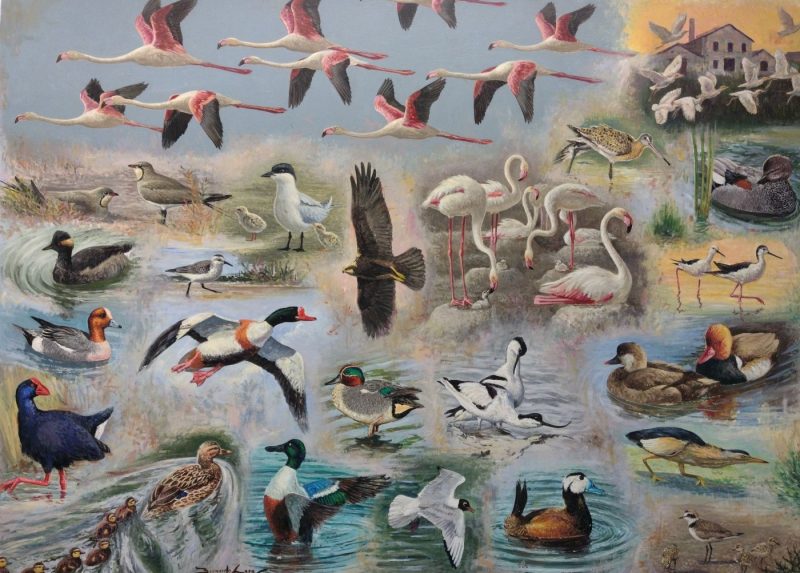
Visual guide to the birds of Doñana and Andalusian wetlands
We have already published a list of Andalusian birdsvery useful for ornithologists who already know their species. The following is an illustrated guide to the hundred or so species of waterbirds present in Andalusia, which represent about a third of the region’s avifauna.

Spoonbills and ibis; Greater Flamingoes; Cranes in Spain
Pelecaniformes (Spoonbills, Ibis), Phoenicopteriformes (Greater Flamingoes), Gruiformes (Cranes). Birds of large wingspan, long legs and slender neck. Their bill is the key to their diet: Spoonbill (filterer), elongated and curved (scavenger), specialized filterer or short and robust (generalist). They are long-lived and have a powerful flight.
Very emblematic species of the wetlands of the Iberian Peninsula, large in size and very easy to recognize. Very gregarious birds that often move in large flocks and form communal roosts and breeding colonies. These breeding sites are very sensitive to disturbance. For feeding, they occupy shallow water areas, both fresh and brackish.
Large waders with elongated beaks
Colonial birds in heronries
Common Spoonbill


GLOSSY IBIS


Breeding season. Spoonbills and Glossy Ibis join herons in their mixed arboreal aviaries. Glossy Ibis have experienced an extraordinary expansion in the marshes of the Lower Guadalquivir in the last two decades.
Large filtering billed waders
Occupants of salt ponds
Greater Flamingo


Lesser Flamingo

Everything about this species is extraordinary, especially its spectacular coloration: Greater Flamingoes mate for life, build elevated cup-shaped mud nests in the middle of shallow lagoons, lay only one egg a year and raise their chicks in communal nurseries. Greater Flamingoes breed only occasionally in Doñana, with the large Spanish colony located at Fuente de Piedras.
Large short-billed waders
Roost places in winter
Common Crane


As for the Common Crane, they only spend the winter in Andalusia, sleeping with their feet in the water, but feeding in the pastures and fields. Their powerful trumpeting can be heard for miles, coordinating the movements of the flock.
Herons and storks of Andalucía
Pelecaniformes (Ardeidae – herons) and Ciconiiformes (Ciconiidae – storks). Slender waders with very long necks and straight, robust and sharp bills, a perfect weapon for stalking. Long legs for wading. Many colorful white or black and white species.
From colonial species that form noisy heronries in trees, to solitary masters of camouflage in reed beds. Their diet is mainly piscivorous, although some are generalists. They are distributed throughout the water (stalking from the shore), areas of emergent marsh vegetation (reed beds) and riparian forests (breeding colonies and roosts).
Social and colonial larde birds
Most common species
White Stork

Cattle Egret

The White Stork and Cattle Egret, whose bill dimensions differ, are both generalists and feed in the terrestrial environment including on landfills. The cattle egret follows cattle to catch frightened insects.
Other piscivorous herons
Grey Heron

Little Egret

Night Heron

Squacco heron

They are generally colonial and social species, usually grouped in aviaries located in large trees of the riparian forest and often harboring several species (mixed colonies): communal roosts in winter and very dense breeding colonies in spring.
Reed herons
Colonials vs. solitaries
Purple Heron

Little Bittern

Bittern

These migratory species are the most sensitive and specialized in the family. All three occupy well-preserved reedbeds. The imperial nests in colonies within them; the Bittern and Little Bittern are solitary and mimetic.
Ciconiiformes more abundant in winter
Ciconiidae vs Ardeidae
Black Stork

Great White Egret

The Black Stork is forest-dwelling and migratory, with increasing numbers of small groups wintering in the south.
Coots, Common Coots and chicks of Doñana
Gruiformes (Rallidae). Small to medium-sized birds, with compact bodies and relatively short legs but with very long toes, adapted for walking on floating vegetation. Short and strong beak
Generally discreet and solitary, they move stealthily through the vegetation. They are mainly herbivores, and therefore closely linked to belts of emergent vegetation (reeds, cattails) and masses of floating vegetation. Together with ducks and geese, they are the only wetland bird species with a fundamentally herbivorous diet, a circumstance that facilitates their presence throughout the year.
The exception of diving coots
Common Coot

Red-knobbed Coot

Unlike other rails, coots have webbed feet that make them excellent swimmers and move through the water with the ducks. Red-knobbed Coots are very rare and difficult to distinguish outside of the breeding season.
Resident birds typical of Mediterranean shores
Moorhen

Purple Swamp-hen

The small ralids are extremely inconspicuous… though not all of them like the splendid porphyry-colored Purple Swamp-hen. The latter is unique in European fauna: it plucks young shoots from phragmites with a powerful peck, which it then manipulates with its long fingers (as if it were a real hand).
Invisible” ears
Water Rail

Spotted Crake

These species are difficult to observe due to their habit of hiding among the perilagunar vegetation. They give themselves away by their voices, but seeing them requires patience and luck.
PISCIVOROUS DIVING BIRDS
Podicipediformes (Podicipedidae – grebes) and Suliformes (Phalacrocoracidae – cormorants). These birds, whose silhouette is somewhat reminiscent of ducks, have hydrodynamic bodies and legs set far back, with lobes (grebes) or complete interdigital membrane (cormorants), ideal for underwater propulsion. Sharp beaks for catching fish.
Excellent divers that pursue prey underwater. Grebes are more solitary and build floating nests; cormorants are gregarious and dry their wings in the sun while perched.
Wetland habitat: They require permanent and relatively deep bodies of water, such as central lagoons or canals, where they find their sustenance throughout the year. Piscivorous species that find prey throughout the year.
Solitary Grebes
Little Grebe

Black-necked Grebe

Medium-sized grebes and grebes are solitary, both resident in Andalusia. In nuptial plumage, the common has chestnut cheeks; the black-necked is dark, with golden ear tufts and a slightly raised bill.
Social cormorants
Great crested Grebe

Great Cormorant

As for the Great Cormorants, they are larger, social and colonial birds, which often join the herons to roost in the aviaries, remaining somewhat distant from the roost of the herons. They have recently begun breeding in southern Spain. Their numbers increase considerably during the winter.
Mediterranean wetland geese and ducks
Anseriformes (Anatidae). The group par excellence of the aquatic birds. Robust, broad, flattened body, webbed foot and broad, flattened bill, often with internal lamellae for filtering. Very distinctive plumage, especially in males.
Very gregarious. They feed in the water or graze on land (geese). Many are long-distance migrants, forming large winter concentrations. Wetland habitat: They focus their activity on the open water surface, where they rest, feed and protect themselves. They use the banks and peripheral meadows for grazing.
The diet of ducks is based on aquatic plants, opportunistically incorporating invertebrates and other small animals depending on availability in the wetland. Their digestive system is highly adapted to process large quantities of plant material: grasses, seeds, roots, stems and leaves of aquatic plants. This is their primary and sustained source of energy.
- Geese graze in the grasslands adjacent to the lagoons.
- Surface ducks adopt an upright posture (“pitching”) to filter water and sediment.
- Diving ducks appear and disappear reminiscent of grebes. They look for aquatic vegetation growing in the water column or on the bottom of the lagoon.
Common resident species
Also the most common wintering anatidae
Mallard

Shelduck

Northern Shoveler Duck

Common Scoter

Easily identified in the field, the common breeding anatidae are visible throughout the year in Andalusia. However, their populations increase considerably in winter when they receive migratory birds from the north.
Male ducks are usually very colorful, while females have inconspicuous and cryptic plumage. As pairs are formed in winter, it is common to observe both sexes in pairs, or even insistent males in search of a mate.
Threatened southern Anatidae
Surface ducks
Red-crested Pochard

Marble Teal

Diving ducks under threat
The species resident in the Mediterranean basin and the Near East are the most endangered and have very scarce populations in Andalusia, mainly in the Doñana wetlands.
White-headed Duck

Ferruginous Duck

These elegant and endangered ducks require permanent pools of water to survive throughout the year. Like all breeders, they are sensitive to habitat destruction and predation.
Doñana, the great winter quarters
Most common species
Greylag Goose

Common Teal

Doñana is famous for its wild geese winter quarters that housed almost the entire European population until the 1980s.
Ducks more localized in winter
Gadwall

Pintail

Wintering bird populations have been increasing in recent decades, reflecting the improvement of wetlands throughout Europe. However, they depend on the availability of water during the winter in Doñana. Prolonged drought and overexploitation of aquifers in Andalusia have led to sharp and significant declines in these species.
Migratory only in passage
Garganey

Most of the aquatic birds continue their journey to the wetlands of West Africa, particularly the deltas of the Senegal and Gambia rivers. Some, such as the Garganey, a long-range migrant, only make short stops in Andalusia during their journey.
Doñana’s waders: 28 small waders in the marshlands
Charadriiformes (several families: Charadriidae, Scolopacidae, Recurvirostridae, etc.). Very diverse group but with a common pattern: compact body, generally long legs and beaks of various shapes (long, short, straight, curved), which define their feeding niche in the substrate, preferably in mudflats and other silty areas.
Most are long-distance migrants, forming flocks during passage and wintering. They feed by pecking or probing the silt for invertebrates. Some breed on the ground in loose colonies.
Wetland habitat: Typical of silty areas and clear banks that are exposed by changes in water level (silt, muddy beaches, salt marshes). Resident (Black-winged Stilt, Avocet, Plover) and summer (Collared Pratincole) waders usually breed in small, scattered colonies, laying eggs on the ground on high ground (“veta”, “pacil”, “isla”) in the middle of mudflats.
Most of them are present during the winter and/or migration period, which they perform between the coasts of West Africa, where they winter, and the extreme north of Western Europe, where they breed. The Atlantic flyway is one of the largest and favors large concentrations of birds.
How do so many similar birds feed together in mudflats … a question that beautifully illustrates the concept of ecological niche. It is enough to observe the shape and size (length and thickness) of the beaks to understand that they allow them to access food resources (worms, bivalves) in differentiated strata of mud.Et voilà! These morphological differences also help us to identify birds in the field.
It is important to “make the eye” on a reference species (Common Redshank; Dunlin, etc.) that allows comparison with individuals that do not correspond to this type.
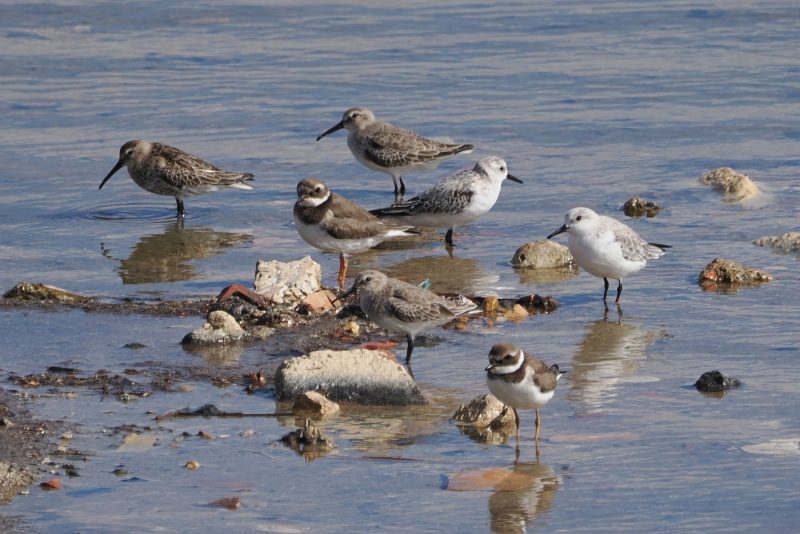
We can distinguish between larger waders (Black-winged Stilts, Avocets, Pintails, Curlews), medium-sized waders (Sandpipers, Black-winged Stilts, Lapwings, Common Snipe) and small waders (Sandpipers, Plovers).
Large sized waders with long beaks
> Black and white pattern (pied)
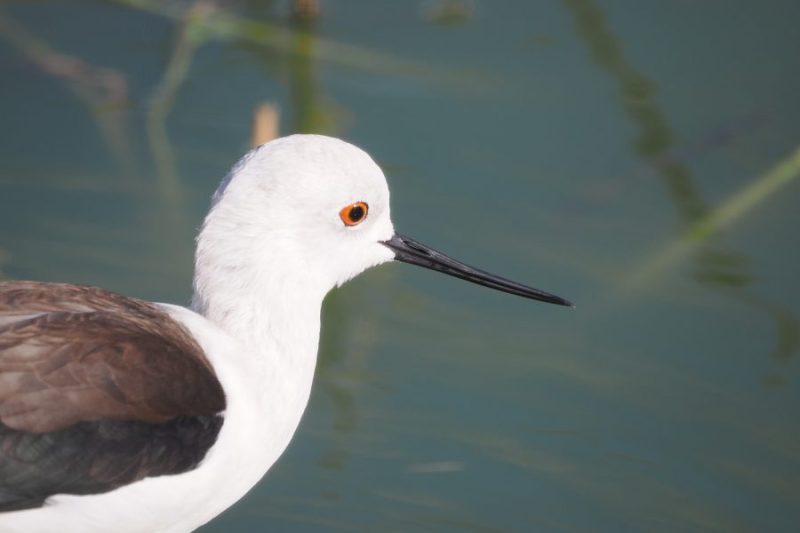
Black-winged Stilt

Avocet

Two species easy to recognize, at the same time social and territorial, in small lax colonies. The common stilt calls very often and makes the first unmistakable sound of the Mediterranean wetlands.
> Long straight beak
Black-tailed Godwit Needle

Bar-tailed Godwit

Very similar. In flight, the black-tailed godwit shows a broad white wing band and a white obisk.
> Long and curved beak


The Eurasian curlew is larger, with a very long and evenly curved bill; the Whimbrel is smaller and has a dark stripe on the head.
Medium sized waders with long beaks
> Orange legs and beak
Common Redshank

Spotted Redshank dark

Beak length is the best indication, longer in proportion in the Spotted Redshank.
> Species of singular appearance
Common Sandpiper

Ruff

The sandpiper swings incessantly. The Ruff has scaly plumage with dorsal feathers that rise easily in the wind.
> Without the above features
Large Green Sandpiper

Wood Sandpiper

These two very similar species for the beginner are learned with experience.
> With distinctive beaks
Common Greenshank

Marsh Sandpiper

The light one is large, grayish, with a long beak and slightly curved upwards; the thin one is smaller, slender, with a straight and very thin beak.
Medium sized waders with short beaks
> Larger size and robust appearance
European Lapwing

European Golden Plover

Two species more common in winter crop fields.
> Smaller size and graceful appearance
Great Ringed Plover

Little Ringed Plover

They differ in the color of the legs, respectively, yellow, pink and black, which may be covered with mud. The Great Ringed Plover has a white eyebrow; the Little Ringed Plover a yellow circle around the eye and the Kentish Plover, a chocolate-colored cap and interupted ventral band.
Short-legged waders
> Very elongated beak
Common Snipe

Jack Snipe

Difficult to recognize: Jack Snipe is very sparse, frequent nodding and a third apical stripe on the head.
> Short beak and swallow appearance
Common Collared Pratincole

Atypical wader that looks like a cross between a swallow and a sandpiper. A summer species that nests in colonies on the bare ground of salt marshes and dry marshes, where its cryptic plumage camouflages it perfectly.
Smallwaders
> Typical (reference) species
Dunlin

Species very variable and intermediate in all its characters, with the beak slightly curved downwards.
> Distinctive appearance
Curlew Sandpiper

Red Knot

Curlew Sandpiper with a more curved and elongated beak. Red Knot due to its large size.
> Smaller common waders
Little Stint

Temminck’s Stint

Both species are very similar and need a lot of experience. The color of the legs is black in the Little Stint and light in the Temminck’sStint.
| Little Stint | Temminck’s Stint |
|---|---|
| Very abundant migrant (large flocks). | Scarce and local migrant (solitary individuals or small groups). |
| Common overwinterer. | Very rare/accidental overwinterer. |
| Intertidal zones, open marshes, salt marshes. | Vegetated freshwater banks, streams, marginal ponds. |
| Very gregarious (flocks of tens to thousands). | Solitary or in small groups, discreet. |
| Fast and coordinated wing flight. | Low and erratic flight. |
| High-pitched call, ” tirrit “. | Very characteristic high-pitched vibrating call, “trrrriit”. |
Terns and gulls of the Mediterranean littoral lagoons
Charadriiformes (Laridae). Aquatic birds of robust (gulls) or slender (terns) appearance. Strong and hooked beak (gulls) or sharp (terns). Long wings for powerful and often graceful flight. Highly mobile birds with high numbers during migrations.
Very gregarious, noisy and opportunistic species. They feed on fishes (by flying or diving), invertebrates or carrion. They nest in colonies on the ground, often on islands. They are ubiquitous in coastal wetlands. The more generalist species (such as the Black-headed Gull) penetrate inland, using ponds, garbage dumps and fields.
To classify this group under the simple opposition “coastal-wetland” is simplistic, since many of its species are more abundant inland. In addition, the large wetlands at river mouths are intrinsically coastal in nature.
Gulls
Black-headed Gull

Slender-billed Gull

The Slender-billed Gull is restricted to very few localities in Andalusia, mainly coastal saltwater lagoons.
Marsh terns
Whiskered Tern

Black Tern

Terns practice “flight stalking”, followed by dive-biting, and feed mainly on small vertebrates in the water column.
Large terns
Gull-billed Tern

Caspian Tern

The Gull-billed tern is white, with a black hood and a robust black bill. It breeds in inland peninsular wetlands. The Caspian Tern is much larger, with a coral-red bill and a powerful appearance, and is more abundant in winter.
Passerines of the Andalusian wetlands
Passeriformes (several Families: Acrocephalidae, Motacillidae, Cisticolidae, etc.). Small birds, with medium-sized bills adapted to their diet: long and thin in insectivorous birds, short and conical in granivorous species. Very varied silhouettes and colors, often cryptic. These birds are very noticeable during breeding by their songs.
They occupy very specific niches in the dense perilagunal vegetation. Many are summer insectivores and migrants, while granivores or generalists, able to forage by digging in the ground and trunks, may be resident or wintering. Habitat in the wetland: Strictly linked to the vegetation structure of the perilagunal belts, which varies greatly according to soil hygrometry, creating a gradient from more to less wetness: dense reedbeds, reedbeds, peripheral wet meadows and riparian forest. Each species has its preferred stratum.
Reed grounds
Bluethroat

The species most closely associated with flooded reed beds, it inspects waterlogged soil among emergent vegetation (helophyte plants). In the Iberian Peninsula, the subspecies present is the nominal one(Luscinia svecica svecica) with white medallion in the center of the large blue pectoral patch.
Marsh species
Reed passerines are mainly insectivorous, a circumstance that conditions the elongated shape of their beaks and their presence in summer or during the migratory phase.
Common in cane fields in springtime
Reed Warbler

Great Reed Warbler

The Great Reed Warbler is small, with a repetitive and monotonous song; the Great Reed Warbler is much larger, with a powerful and raspy voice. They colonize patches of emergent vegetation (reeds, rushes) where the ground is most often covered with water.
Discrete and passing species
Savi’s Warbler

Sedge Warbler

Two reed passerines that need experience to identify. The very inconspicuous Savi’s Warbler, easier to spot because of its repetitive song similar to that of the cricket insect. The Sedge Warbler resembles a reed warbler with a broad eyebrow.
Wintering and scarce
Reed Bunting

Not easily confused with the stature reminiscent of the sparrow.
Open environment species
Pipits
Zitting Cisticola

Yellow Wagtail

Birds of more or less humid prairies. They tend to concentrate in wetlands or their periphery (especially in winter), although they are not strictly dependent on them.
Pipits
Meadow pipit

Water pipit

This group of birds is difficult to identify and requires considerable experience to recognize. Meadow Pipit is the most common.
Swallows
Barn Swallow

Sand Martin House Martin

Barn Swallow and Sand Martin: Both exploit swarms of insects generated over water, but with different breeding habitats. The Barn Swallow nests in human constructions, while the Sand Martin is a specialist: it digs its nests in sandy river slopes and riverbanks, a threatened habitat intimately linked to the fluvial dynamics of the wetland.
Riparian species
As strict riparian species, their distribution is conditioned by the presence of the gallery forest. This perilagunar forest belt acts as an ecological corridor that provides them with food, shelter and nesting sites, explaining their high density in these margins of the wetland.
Resident species in the riparian forest
Cetti’s Warbler

Penduline Tit

Summer visitors
W. Olivaceous Warbler

Rufous Nightingale

Birds of prey
Accipitriformes (Accipitridae, Pandionidae) and Strigiformes (Tytonidae, Strigidae). Specialized predators. Hook-billed, powerful talons (diurnal raptors) or cryptic plumage and silent flight (nocturnal). Broad wings for gliding or low flight.
They control populations of waterfowl, fish and small mammals from the air. Some are strict specialists (Marsh Harrier, Osprey), others opportunistic visitors. Wetland habitat: Need large open areas for hunting (harriers, Western Barn Owls) and perches or tall trees for nesting or guarding (Osprey).
Diurnal raptors
Specialist of the reed bed vs. piscivore
Marsh Harrier

Osprey

The Marsh Harrier is primarily a resident species, prowling low over reed beds in search of dead waterfowl and small mammals. The Osprey is a common wintering open water hunter; with unique adaptations (rough talons, nostrils that close when diving), it is the only raptor that dives completely to catch fish.
Nocturnal raptors
Short-eared Owl

Short-eared Owl: Scarce winter visitor. Recognizable by its long wings and intense yellow eyes. It frequents open flooded lands, where it hunts small mammals in low flight.
FAQ
What is the best time of the year to visit the Andalusian wetlands?
Winter (December – February): Epodean peak. The wetlands host hundreds of thousands of wintering birds from northern Europe. This is the best time to see large concentrations of geese, surface ducks (shovelers, gadwall, widgeons, waders and cranes on their roosts.
Spring (March – May): Breeding season and prenuptial migration. The lagoons are full of color and activity with birds in nuptial plumage. Summer birds such as the Purple Heron, Collared Pratincole and Collared Pratincole arrive. This is the best time for diversity and breeding behavior.
Summer (June – August): Quieter period but with resident (Purple Swamp-hen, Purple Swamp-hen) and colonial (egrets, Spoonbills) flagship species. The central hours are very hot; it is necessary to get up early.
Fall (September – November): Postnuptial migration. Large passage of waders and marsh passerines. Good time to detect rarities among the flocks.
Do I need a guide or can I visit on my own?
Both options are valid:
On your own: It is possible and rewarding. The network of trails and observatories in areas such as Doñana, Fuente de Piedra or Desembocadura del Guadalhorce is very well signposted, although sometimes reduced depending on the protected area. Previous preparation is required. There are restricted accesses that require prior authorization or are simply prohibited.
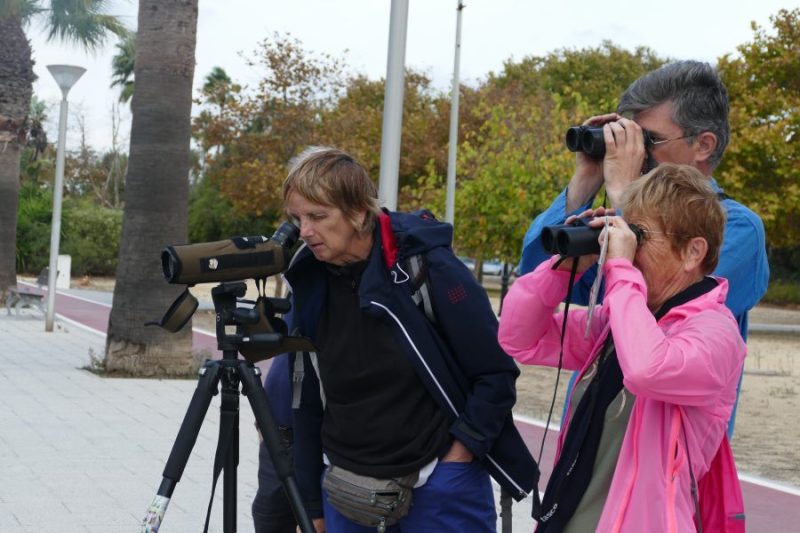
With a specialized guide: It is highly recommended, especially for a first visit. Beyond the detailed knowledge of the terrain, the local guide facilitates access to restricted areas; transports with all-terrain vehicles to access observation points not accessible by tourism; and allows sightings with powerful telescopes, essential to really enjoy the observations.
What standards of ethics and behavior should I follow?
The priority is the welfare of the birds and the conservation of the area:
- Always keep your distance. Use observatories and hiding places. Never force a bird to fly or hide because of your proximity.
- Do not use playbacks in protected natural areas. It is forbidden and stresses birds, especially during the breeding season.
- Respect the trails. Do not leave the marked trails to avoid stepping on nests on the ground or degrading the habitat.
- Silence and discretion. Speak softly, dress in discreet colors (green, brown, beige) and avoid sudden movements.
- Leave no trace. Take away all garbage, including organic waste.